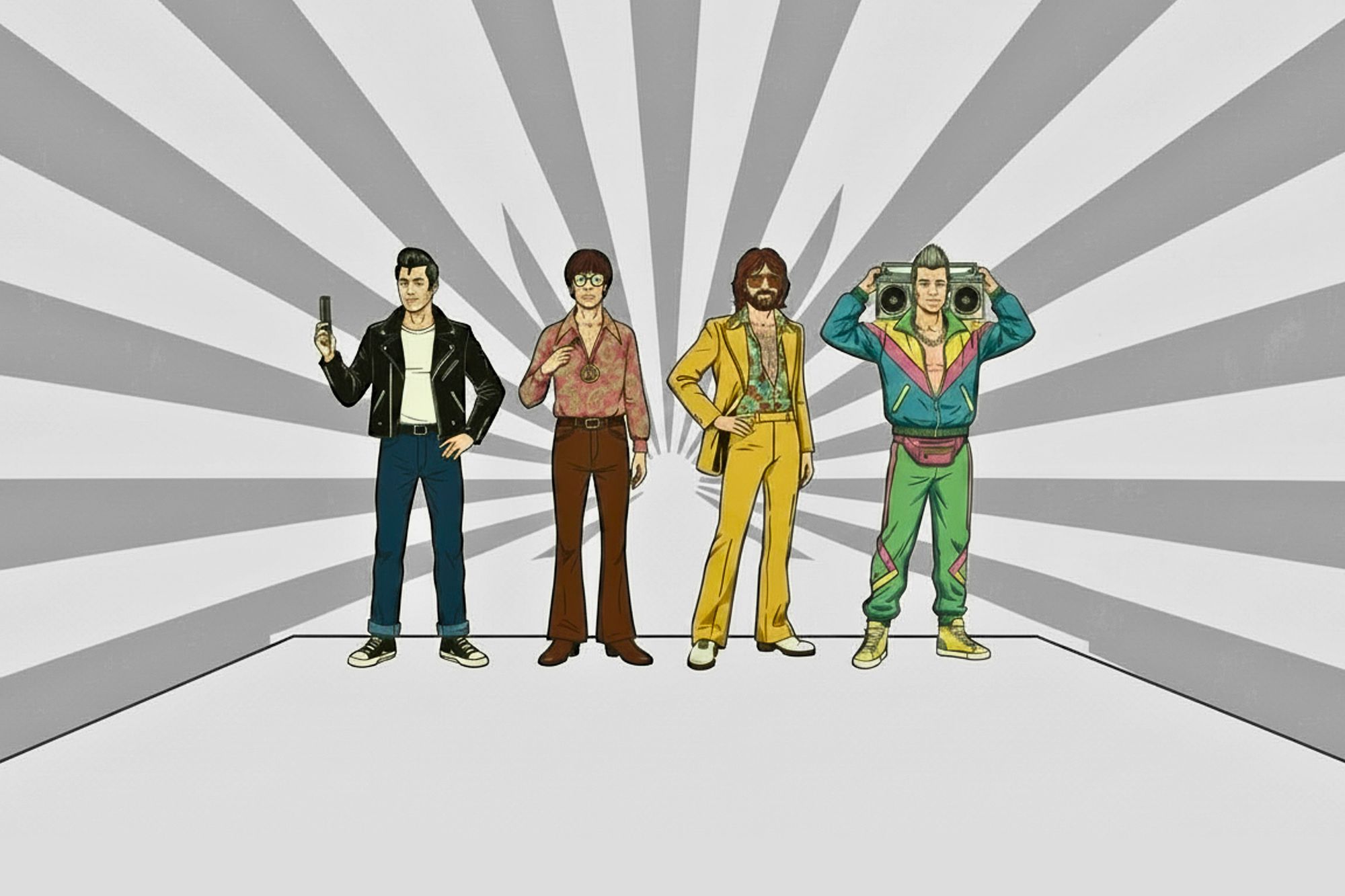
Many people carry a deep, persistent longing for a decade they may never have even lived through. That feeling can be hard to explain.
Far from being a quirk or an eccentricity, this longing is rooted in very real psychological needs and well-documented human tendencies.
Understanding those needs doesn’t make the feeling go away, but it does something arguably more valuable: it helps you understand yourself.
And self-understanding, as most people who have done the inner work will tell you, is where everything worthwhile begins.
1. Nostalgia is a powerful psychological force.
After studying nostalgia for decades, psychologist Constantine Sedikides found that it functions as a notable psychological resource.
When people feel nostalgic, their mood lifts, their sense of loneliness decreases, and their feelings of meaning and purpose increase. That’s a significant emotional return for simply remembering an old song or catching a familiar scent.
Nostalgia is technically a bittersweet emotion that is part warmth, part ache. The ache is important. Ordinary remembering doesn’t make you wish you could go back, but nostalgia does. That longing quality is precisely what transforms a pleasant memory into a powerful emotional pull toward another time entirely.
Even for people who didn’t live it, the past can feel like home. They might be experiencing nostalgia-by-proxy based on parents’ and grandparents’ stories or from consuming media from those decades. And when the present feels chaotic or hollow, the psychological draw toward that imagined home becomes extremely hard to resist.
2. Your brain has been editing the past into something better than it was.
There’s a well-studied cognitive bias called “rosy retrospection,” identified by researchers Mitchell, Thompson, and colleagues, which describes our brain’s tendency to remember past experiences more positively than we actually felt them at the time.
Negative details fade. Positive ones are preserved and often amplified. The result is a highlight reel masquerading as history.
When applied to entire decades you never lived through, this effect becomes even more pronounced. Nobody’s brain is filing away the Cold War anxiety of the 1960s or the economic stagflation of the 1970s. What gets stored—and endlessly reinforced by films, TV shows, and cultural mythology—is the aesthetic. The diners, the fashion, the music, the apparent simplicity.
What you’re longing for, in other words, is largely a construction. A deeply compelling one, but a construction nonetheless.
The 50s, for instance, were also an era of profound racial injustice, rigid social constraints, and widespread political fear. The 70s brought oil crises and social upheaval. Recognizing this is about understanding that the past you’re drawn to is, at least partly, a very human act of imagination, though the longing you feel is still valid.
3. Modern life is exhausting in ways previous generations simply didn’t have to deal with.
There’s a growing body of research around something called “technostress”—the psychological strain caused by our always-on, always-connected digital existence.
You’re not alone in finding it all a bit much. The expectation to be reachable at all hours, the relentless scroll of bad news, the algorithms engineered to keep you emotionally activated—none of this existed before the internet age. Past decades, whatever their real flaws, did not subject people to this particular kind of pressure.
Climate anxiety, political polarization, economic instability, and the sheer volume of decisions modern life demands of us all compound this exhaustion.
So, when you imagine a random Tuesday in 1974—perhaps a simpler job, an evening watching television with the family, no smartphone anywhere in sight—what you’re really craving is relief. The past feels like a place where your nervous system could finally rest. That’s an entirely understandable response to a world that rarely lets it.
4. Facing too many choices is a real psychological problem.
Psychologist Barry Schwartz, in his influential work The Paradox of Choice, demonstrated that having more options doesn’t make people happier. Conversely, it frequently makes them more anxious, more indecisive, and ultimately less satisfied with whatever they choose.
The modern world offers almost unlimited options for careers, identities, lifestyles, and values. For many people, that freedom feels less like liberation and more like an unrelenting pressure to get everything right.
Past decades, at least in the way we imagine them, offered something the mind finds deeply soothing: clarity. You had a clearer sense of what a good life looked like. Your career path was more defined. Your role in your community was understood. Nobody was asking you to build a personal brand or decide between seventeen different versions of who you might become.
Cognitive simplicity is a genuine psychological need. The brain expends real energy on decision-making, and when that energy is perpetually drained by an overwhelming number of choices, the mind naturally gravitates toward times and places where things felt more straightforward.
Whether that simplicity was entirely real is almost beside the point. The perceived clarity of the past is enormously appealing when the present feels so relentlessly complex.
5. The longing for community goes deeper than you might realize.
Robert Putnam’s landmark research, published in Bowling Alone, tracked a dramatic decline in social capital across American society over the latter half of the 20th century—a drop in the kinds of everyday community connections that once made people feel embedded in something larger than themselves.
Neighbors who knew each other well, local organizations, multi-generational households, and shared public rituals have all eroded significantly.
Humans are wired for belonging. Not just the digital kind, but the kind where someone knocks on your door, where the whole street turns out for a celebration, where your life is interwoven with the lives of the people around you. That level of social connection is tied to mental health, longevity, and a sense of meaning.
When you picture the 60s or 70s, that sense of community is often part of what you’re picturing, even if you don’t consciously name it. The longing for a past decade is very frequently, at its core, a longing to feel truly known and connected.
That ache is worth paying attention to because it tells you something real about what you need right now.
6. Moral nostalgia is real, and more nuanced than it first appears.
Some people are drawn to earlier decades because they feel modern society has lost something morally or socially valuable: a sense of craftsmanship, loyalty, civic duty, or basic courtesy between people.
Researchers refer to this as “moral nostalgia,” and it reflects a psychological discomfort with the sense that shared values have fragmented or dissolved entirely.
Have things changed? In many ways, yes. The cultural cohesion that once came from shared institutions, religious communities, and civic life has undeniably weakened. Feeling unsettled by that shift reflects a real and thoughtful response to actual changes in society, not a failure to “move with the times.”
That said, this particular form of longing requires some honest self-examination. Past decades, for all their perceived moral clarity, were also eras of deeply embedded injustice.
Racial segregation, the systematic exclusion of women from public life, and the persecution of LGBTQ+ people were not fringe issues. They were features of the very social fabric that felt so orderly and cohesive.
Holding both of these truths simultaneously—that something real has been lost and that the past also caused profound harm—is uncomfortable, but important. The most meaningful version of moral nostalgia isn’t a wish to return, but a desire to carry forward what was worth keeping.
7. Your brain craves predictability.
Psychological research is remarkably consistent on this point: routine and predictability are foundational to mental wellbeing. When life feels stable and rhythmic, anxiety decreases. When it feels chaotic and unpredictable, the nervous system stays on high alert.
Modern life, with its constant technological disruption, shifting social norms, and economic uncertainty, offers precious little of the stability the brain needs.
Earlier decades—particularly as we imagine them—were structured around reliable rhythms. Religious observances, seasonal patterns, family routines, and community traditions gave life a shape that people could depend on. Even work followed more predictable patterns. You didn’t receive emails at midnight or pivot your entire career every three years.
Ritual, specifically, carries a remarkable amount of psychological weight. Anthropologists and psychologists alike have noted how shared rituals create cohesion, reduce anxiety, and give individuals a felt sense of their place in a larger story.
The appeal of past decades often includes, somewhere in it, a hunger for that kind of grounded, rhythmic existence; a life with a recognizable shape from one week to the next.
8. Some people feel out of place in their own era.
There’s a concept that some psychologists and sociologists have begun to explore called temporal alienation, which is the experience of feeling chronologically misplaced, as though your values, your sensibilities, and your ways of engaging with the world simply belong to a different time.
This goes considerably beyond nostalgia. Nostalgia is a feeling you move in and out of. Temporal alienation is closer to a persistent identity experience.
People who feel this way often describe a low-level but constant sense of friction with the modern world. They don’t simply dislike certain aspects of it; they feel fundamentally at odds with its pace, its priorities, and its values.
The present era, for them, doesn’t fit. And that kind of chronic misalignment is exhausting in a way that’s hard to articulate to people who don’t share it.
What’s striking is how creatively people respond to this feeling. Subcultures built around specific decades—vintage communities, mid-century enthusiasts, groups organized around the music, fashion, and aesthetics of a particular era—are often populated by people working through exactly this experience. They’re building micro-environments that feel more like home. That is a deeply human search for belonging in time, not just in place.
9. The thing you’re craving might simply be time itself.
Does modern life actually move faster, or does it just feel that way? It’s probably a bit of both. The pace of information, social interaction, cultural change, and professional expectation has accelerated dramatically, and the human brain, which evolved over millennia for a considerably slower world, is struggling to keep up.
Earlier decades, whatever their limitations, operated at a human pace. Letters took days to arrive. Conversations happened in person. Trends shifted over years rather than weeks. There was space—actual, unhurried space—to think a thought through, to feel an emotion fully, to simply be present in a moment without the competing pull of a dozen notifications.
The growing “slow living” movement reflects an increasingly widespread recognition of this psychological hunger. People are consciously stepping back from speed in whatever ways they can, and finding that their wellbeing improves when they do.
So, when you long for the 1970s, you may not be longing for flared trousers or rotary phones specifically. What you may be longing for, in the most fundamental sense, is permission to slow down, and enough quiet space to actually feel your own life as it happens.
Final Thoughts
Understanding why you feel drawn to another era is worthwhile—not as an intellectual exercise, but as an act of self-compassion. Each of the reasons explored here points to something real: a need that deserves to be taken seriously, not explained away.
You deserve the things you’re longing for. Belonging. Simplicity. Meaning. Rhythm. Depth. The fact that you associate those things with the past doesn’t mean they’re unavailable to you now.
In many ways, recognizing what you’re truly hungry for is the most important step. From there, you can start to ask how to bring more of those qualities into your actual life, not as a recreation of another era, but as a deeply personal, present-tense response to what your mind and heart are clearly asking for.
The longing itself is worth honoring. Follow it inward, and you may find it has a great deal to teach you about who you are and what kind of life you most want to build.