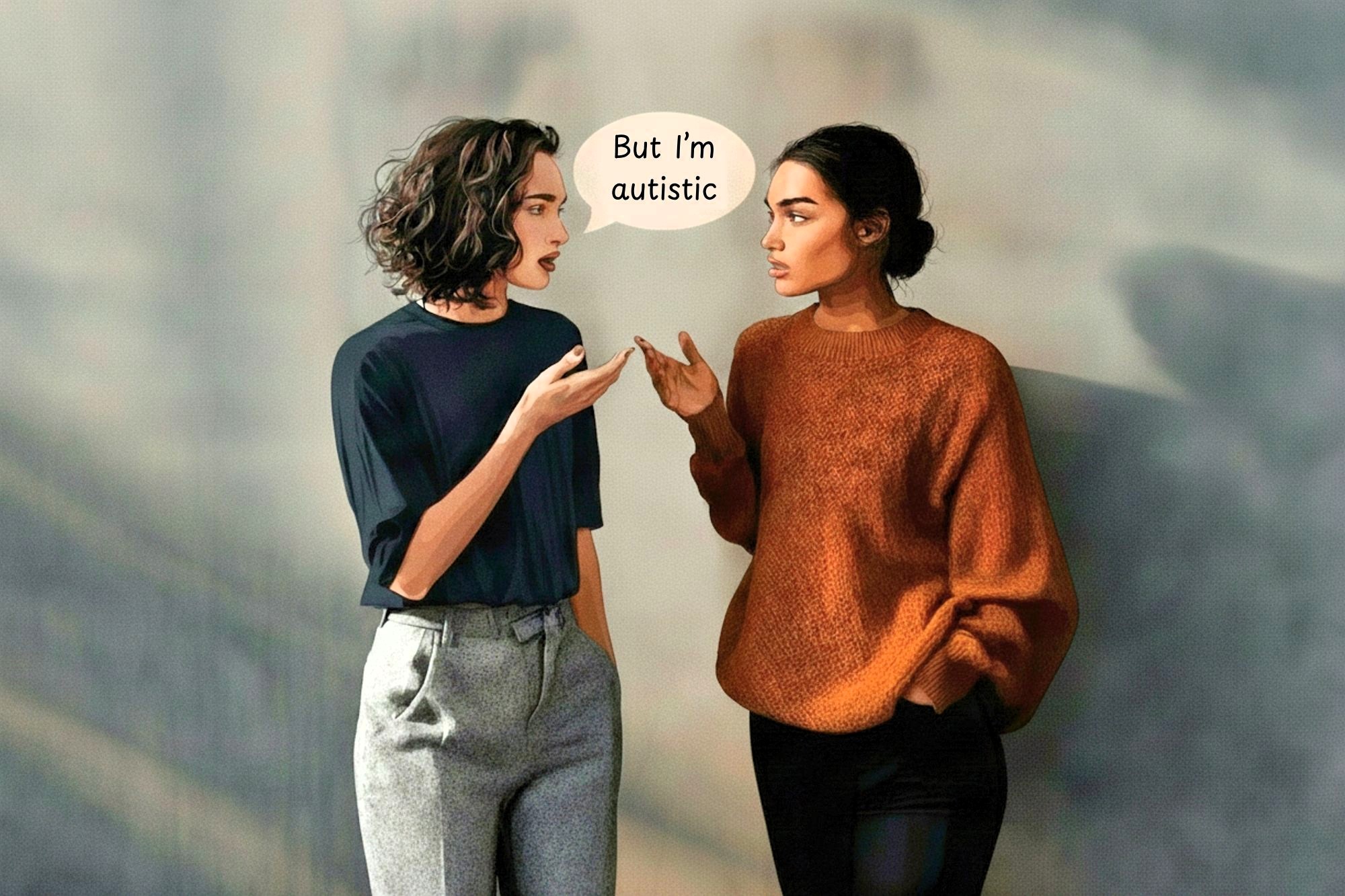
I write all of our articles about neurodivergence, and I edit the rest of our content, and one of the things that always strikes me is the comments and feedback we receive when it comes to common autistic and ADHD behaviors.
On the articles about neurodivergence and the challenges autistic and ADHD people face, there’s almost always someone in the comments saying something along the lines of: “just another person using autism/ADHD as an excuse for bad behavior.”
And on articles that discuss behaviors which cause hurt or harm — regardless of the intention — we get the opposite: neurodivergent readers saying that calling out those behaviors is uninformed neurotypical bias.
Both responses frustrate me in equal measure.
Because, to me, the answer to “is this an excuse or an explanation?” seems to be in part a case of whether the behavior (not the intention) is actually harmful to the person receiving it. After all, different doesn’t necessarily mean bad. Sometimes it just means different, but society and cultural norms have trained us to think it means bad.
But sometimes? Sometimes, different does mean bad. Or maybe not bad as such, but it might mean genuine harm or hurt, at least from the other person’s perspective. And I think that’s worth sitting with.
First, let’s talk about what we actually mean by “bad behavior.”
The word “bad” is doing an enormous amount of heavy lifting in this conversation.
A significant proportion of what gets labeled as bad behavior in autistic and ADHD people isn’t bad at all. It’s different. It’s unfamiliar. It’s sometimes uncomfortable for the neurotypical people around them. But discomfort and harm are not the same thing, and we conflate them far too casually.
Not making eye contact isn’t rude behavior, despite society’s bizarre fixation with it. It does not harm anyone. Needing to leave a loud, overwhelming party early isn’t disrespectful to the host. Keeping yourself to yourself and not making small talk at the school gate, also not rude.
Not following an arbitrary dress code when the clothing causes sensory distress does not actually harm anyone. Giving a direct, no-fluff answer to someone’s question is not inherently offensive. Fidgeting isn’t a problem to be solved unless it’s actually disruptive, and neither is stimming
If you consider these to be the “bad” behaviors someone is using autism or ADHD to excuse, then I’d challenge you to consider if you can actually come up with a legitimate reason about why they even need to be excused. Not just “because it’s not socially acceptable” but an actual, logical reason about why these behaviors are socially unacceptable.
Because none of these things are inherently bad. They are all simply expressions of a nervous system that works differently from the norm, and the confusion or discomfort they occasionally produce in neurotypical observers is not a reliable moral compass.
When neurodivergent people push back against the “bad behavior” label, this is usually what they’re pushing back against. And they’re right to. The neuronormative assumption that there is one correct way to socialize, communicate, and move through the world has caused (and continues to cause) enormous harm to autistic and ADHD people. Calling out that assumption isn’t making excuses. It’s asking people to tolerate neutral differences.
But, as I already mentioned, and some people are going to berate me for, different doesn’t automatically mean acceptable, either. The question we always need to return to is a simple one: is anyone actually being hurt?
So what about the times when natural neurodivergent behavior does hurt people, albeit unintentionally?
This is the grey area, and the part that I suspect will make some people uncomfortable. And it’s the one that tends not to get said in neuroaffirming spaces, for fear of being misread as ableist.
But I think the neuroaffirming position — the genuinely neuroaffirming position — actually requires us to say it.
Let me give you some real examples from my own life.
One natural feature of autistic communication is the tendency to respond to someone else’s difficulty by sharing a parallel experience of your own. The instinct is genuinely empathetic. It comes from a place of “I understand, this happened to me too, you’re not alone.” I do this. It’s my first instinct when someone shares something hard. It’s also something that gets described as a self-centered behavior in many articles about communication.
This, of course, frustrates me, since I consider myself a very compassionate person, and my intentions are certainly not self-centered when I do it. That said, I also know what it feels like to be on the receiving end of it. Particularly when someone takes your difficult thing, briefly acknowledges it, and then pivots entirely to their own story, and the conversation never comes back to you. It feels like being steamrolled, even if that was never the intention.
Understanding the legitimate reason behind your well-intentioned behavior doesn’t make the impact on the other person disappear. You could just say, “I’m autistic, deal with it,” but being autistic doesn’t mean someone else’s feelings and needs are irrelevant.
Yes, neurotypical people should absolutely be a little less judgmental and a lot more accommodating to neurodivergent people’s natural way of communicating. And we should absolutely stop perpetuating myths about neurodivergent forms of communication that aren’t actually problematic.
But becoming a more inclusive society means everyone’s needs and feelings should be considered, and everyone includes neurotypical people, too.
Interrupting people is another good example here. I do it. Quite a lot. This gets labelled as rude (it is a little) or like I’m not paying attention (also true on some counts). But my intention is neither of those things. Often it’s the opposite. I’m so engaged that a thought fires, and if I don’t say it immediately, it’s gone. Or I simply can’t spot the appropriate length pause in conversation that signals the other person is done. Sometimes it’s just that I’m ridiculously easily distracted by my surroundings.
It’s how my brain is wired, and trying to stop myself from doing that in real time, in the middle of a conversation, uses a lot of mental energy that is both exhausting and means I’m not present for the conversation either.
But I also find it genuinely irritating when people interrupt me, especially when it completely derails my train of thought. Which tells me everything I need to know about whether the experience of being interrupted is pleasant, regardless of the interrupter’s intent.
So the explanation — “my brain works this way” — is real and valid. But it doesn’t make the interruption fine for the other person.
Emotion regulation is another grey area. A lot of neurodivergent people struggle with it and with good reason. Their nervous systems are generally more sensitive, and the neurotypical world is naturally overwhelming to them. That said, I think we can all agree that having someone scream in your face or physically lash out at you is harmful (it doesn’t do much good for the neurodivergent person’s well-being, either).
You can’t just say, “I’m autistic” and expect them to tolerate it. There absolutely needs to be accountability here, and a willingness of the neurodivergent individual to identify and reduce triggers early, and learn and utilize strategies to help with emotion regulation.
“I’m neurodivergent, so I struggle with emotion regulation” shouldn’t be an excuse to absolve meltdowns, but rather an explanation of the reasonable adjustments needed to prevent them in the first place (but of course, that requires the people around you to have a little compassion and the willingness to accommodate your needs).
Autism or ADHD can fully explain why something is hard or different, without that meaning the other person simply has to accept being hurt by it indefinitely.
Consistently saying things that wound people or talking over them and meeting every piece of feedback with “that’s just how I communicate” is an excuse. Repeatedly letting people down and responding to every expression of hurt with “I have ADHD, I can’t help it” is an excuse (particularly if you’re not willing to use compensatory strategies to help you). Using autism or ADHD to shut down any and all reflection on your impact on others — that’s an excuse.
An excuse is when saying “I’m autistic/have ADHD” becomes a full stop rather than a starting point. It’s “I’m autistic, and that’s the end of the conversation.” It’s using neurodivergence not to explain impact, but to make impact irrelevant.
What an explanation actually looks like.
It’s worth pointing out that most people who are autistic, ADHD, or both (AuDHD) are painfully aware of the impact their behaviors sometimes have on others. In fact, most neurodivergent people go out of their way not to upset people or cause offense, and they are mortified when they inadvertently do.
These people are not trying to excuse their behavior; they are genuinely sorry for any hurt caused and are trying to explain why that might have happened, despite it not being their intention.
An explanation is context. It’s “this is why I do this.” And at its best, it opens a door. It invites understanding. What’s more, it creates the conditions for accommodation and genuine connection.
When an autistic person explains that they need advance notice before plans change because uncertainty is genuinely dysregulating for them, that’s an explanation.
When they tell a colleague that they can’t process information well over phone calls and need things in writing, that’s an explanation.
When they go quiet and withdraw in a noisy, overstimulating environment and later tell you that they weren’t being rude, they were just hitting a wall — that’s an explanation. And it gives you the opportunity to have compassion, even if you were confused at first.
The same is true for ADHD. When someone explains that they need deadlines broken into smaller chunks because a distant due date simply doesn’t register as urgent to their brain until it’s almost too late, that’s an explanation.
When they tell you that they need to fidget as it helps them to focus, that’s an explanation.
In fact, not only are the examples I’ve given explanations, but they are proactive solutions and requests for reasonable adjustments to help a neurodivergent person mitigate their difficulties. They actually prevent the unwanted, “bad” behaviors, like becoming emotionally dysregulated, missing the deadline, or not being able to pay attention to anything you say.
And the adjustments above are reasonable. They don’t cost anything. And they don’t require special treatment, because they can be made available to everyone.
None of these explanations asks the other person to simply absorb harm. They ask for understanding and, where possible, accommodation. There’s a collaborative spirit to a real explanation — an implicit “now that you know this, here’s how we might navigate it together.”
So how can we honor our unique neurotype without invalidating the other person’s?
I think it’s pretty understandable that neurodivergent people get irate about articles lauding neurotypical behavior as the gold standard and that berate anything that falls short. I do, too.
Many neurodivergent people, especially the late identified, have spent years being told — explicitly or implicitly — that the way they naturally move through the world is wrong. That they’re too much, or not enough, or simply broken in ways that need fixing. The relief of finally having a framework that says actually, your brain just works differently is, for many people, genuinely life-changing.
But I think that relief can sometimes calcify into something less useful: a defensiveness so protective of the neurodivergent experience that it leaves no room for the experiences of the people around them.
And the thing about that is that it actually undermines the argument. If the case for neurodivergent acceptance rests on the idea that everyone’s experience deserves to be taken seriously (and it absolutely does), then that logic doesn’t stop at neurotype.
The neurotypical partner who feels consistently unheard, the friend who keeps getting interrupted, the colleague who never knows which version of someone they’re going to get — their experiences are real, too. Dismissing them wholesale doesn’t advance inclusion. It just reverses the hierarchy. But I recognize that’s a much harder ask for people who’ve spent years having their experience dismissed than it is for people who haven’t.
I think it’s ok to say, “Yes, I do this thing, it’s part of who I am, it’s not done with malice, but I understand it hurts/irritates you, and I’m sorry for that.”
I think it’s ok to say, “Please cut me a little slack for this thing, but I don’t expect you to just take it and pretend it didn’t hurt.”
I think it’s ok to acknowledge that the way your brain is wired comes with many strengths, but XYZ is not one of them, and you’re willing to find strategies to offset that if it genuinely hurts people.
I think it’s ok to accept that sometimes your behavior is challenging to deal with.
Acknowledging that isn’t a betrayal of neurodivergent identity. It’s just acknowledging humanity.
So where does that leave us?
Back at the beginning, in a sense.
The comments we get — “just an excuse for bad behavior” on one side, and the defensive pushback against any accountability on the other — are both responding to something real.
There are people who dismiss genuine neurodivergent differences as a moral failure. And there are people who use neurodivergence as a shield against ever having to consider their impact on others.
Both things are true.
The question “excuse or explanation?” doesn’t have a clean universal answer. It probably never will. But I think the framework is simpler than the debate often makes it seem:
Is anyone being harmed? Not merely inconvenienced or surprised by difference, but genuinely hurt?
Is there a willingness to challenge the beliefs being held about what is genuinely harmful and what is simply unfamiliar?
Is there openness to understanding genuine hurt or harm when it does happen?
Is the disclosure being used as a starting point for understanding and reasonable accommodations, or as a closing argument against ever having to?
Those questions won’t resolve every situation neatly. But in my opinion, they’ll get you a lot closer to the truth than the binary approach.