
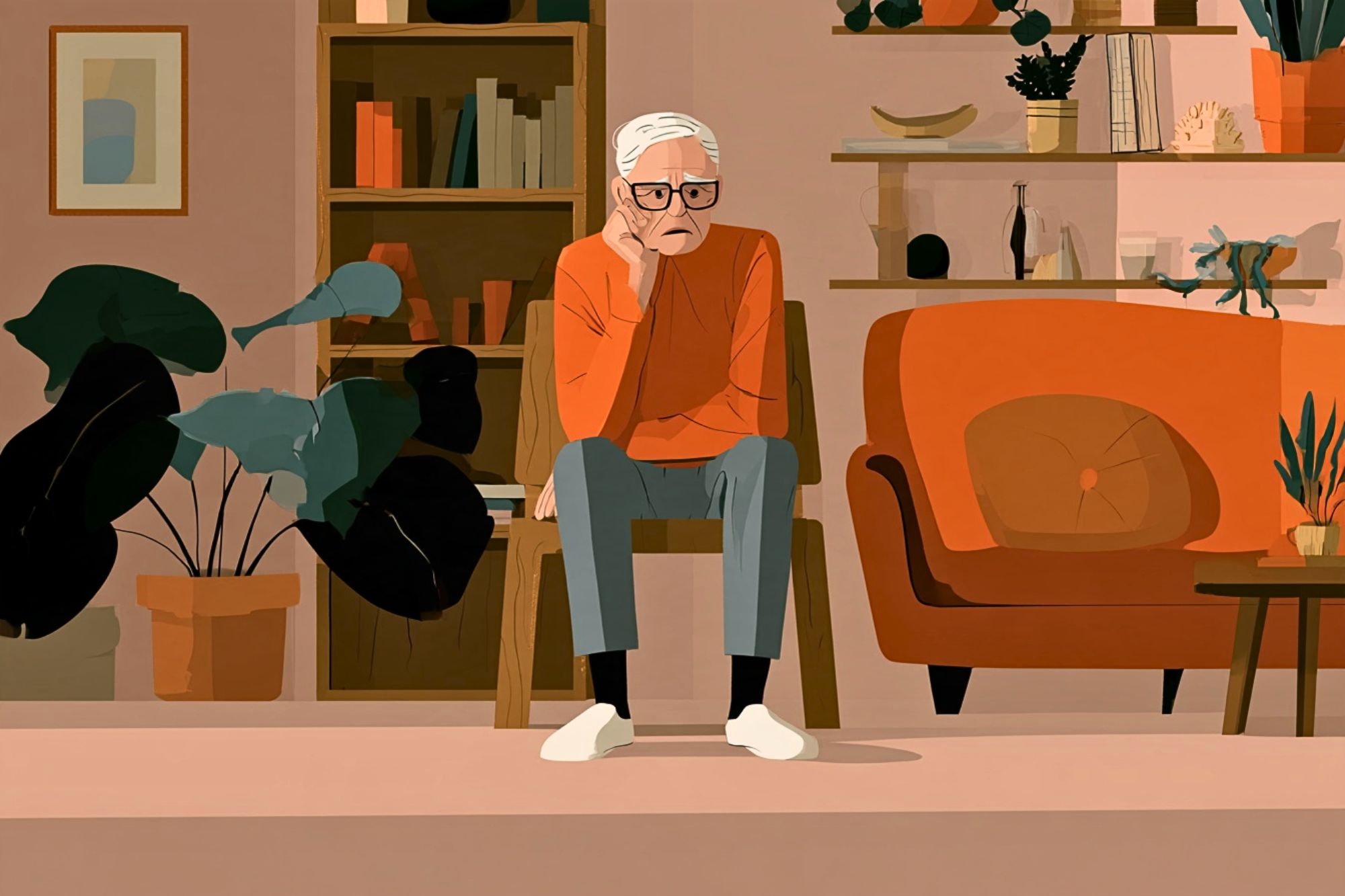
It’s quite natural to feel a bit anxious during your retirement. And it can come at any time—before you leave your job, in the first few months, or even years into a retirement that has so far been enjoyable.
When it shows up, the urge is often to push it away and hope it passes. Yet that uneasy feeling is well worth getting to know. It tends to point toward the parts of your life that need a little more care, attention, or courage.
The tricky task is working out what it’s actually pointing to. Anxiety can be very hard to make sense of. You might feel restless, snappy, or oddly flat for no clear reason. One week you fret about money, the next about your health, and neither seems to fully explain the unease you feel.
That’s where this article can help.
Below, we’ll explore the deeper concerns that often sit beneath retirement anxiety, so you can spot the ones that ring true for you and start doing something about them.
1. “Will I have enough?” often really means “Will I ever feel safe enough?”
For a lot of people, money worry runs on feelings, not facts. You could double your savings tomorrow and still lie awake at 3 a.m. wondering if it’s enough. The feeling of safety doesn’t seem to relate to any particular nest egg number.
However, the form that nest egg comes in does make a difference.
Research by David Blanchett and Michael Finke found that retirees spend about twice as much each year when wealth is held as guaranteed income rather than as investments they must draw down themselves. Why? Well, a steady monthly check can feel safer than a large pot of savings because it reduces the fear of outliving one’s money.
With this in mind, here are some ways you can feel more confident about your financial position (Do not take this as financial advice. Please consult a financial advisor for expert tailored recommendations):
- Turn part of your savings into income. An annuity can cover your basic bills, so the rest feels like spending money.
- Keep a cash cushion. One or two years of costs in an instant access savings account means a bad year for stocks won’t force your hand.
- Think hard about when to claim Social Security. Waiting might mean a bigger check for the remainder of your life.
Also, ask yourself one plain question: What number would actually make me stop worrying? If no answer comes, that’s useful to know. Your money worry may require professional attention instead.
2. “Am I becoming a nobody?”
For her book Becoming An Ex, sociologist Helen Rose Fuchs Ebaugh interviewed 185 people who had left major roles behind. Among them were former nuns, former doctors, and divorced people.
Many went through a stage where they felt like an “ex,” defined partly by who they used to be as well as who they were becoming.
Retirement can bring on that same feeling. After 30 or 40 years, your job tends to take up a huge share of your sense of self. It’s where you feel skilled. It’s where you feel proud. It shapes how you spend most of your waking hours.
Suddenly, when you retire, you have “ex skills” and “ex pride” and an “ex routine”. You see yourself partly as an “ex worker,” with little clear “current” anything.
Psychologist Patricia Linville found that people with a more complex sense of self—made up of multiple, distinct roles and identities—were better buffered against the effects of stress. When one part of life takes a hit, negative feelings are less likely to spill over into the rest of the self.
Someone who identifies as a parent, a gardener, a friend, a cook, and a volunteer has plenty to lean on. Someone whose whole self sits in one place feels the loss of that thing much more sharply.
That goes a long way toward explaining why retirement rocks some people and barely touches others.
Here’s an exercise that can help:
- Grab a sheet of paper and draw a circle for each role you held before retirement.
- Size each circle by how much of “you” it held.
- Look at what you’ve drawn.
If work is the largest circle, your worry could be down to a lack of anything to fill the space that circle held for so long, now that it is not a part of your life.
What’s important to remember here is that we don’t think our way into a new identity. We act our way there through small tests. The more we do a thing, the larger the circle grows on our new page.
That’s why the advice to try new things, take a class, join a group, or say yes to invitations is such good advice. Bit by bit, the blank space where work used to be gets filled by new things.
3. “Am I wasting my free time?”
Plenty of retirees feel ungrateful saying it, but having so much free time on your hands is a little scary. Which is strange when you consider that free time is almost the point of retirement.
A 2021 study by Marissa Sharif, Cassie Mogilner, and Hal Hershfield looked at how free time links to well-being. What they found is that well-being rose as free time grew to about two hours a day. Then it leveled off. But past five hours or so, it actually started to dip.
Why the drop? People felt less productive. They missed that sense of getting something done.
However, they also found that when people spent their free time on things that felt worthwhile, that post-5hr dip was much less pronounced. Hours spent helping, learning, or making something did not show the same decline.
Your worry about boredom, then, is actually your intuition talking. It knows you need more than rest. Retirement will hand you lots of hours, and the trick is to fill some of them with things that matter to you.
The idea isn’t to pack your schedule completely. Be sure to leave plenty of room for lazy mornings and long lunches. Just make sure a few of your days include something that makes you feel useful. That small sense of purpose can make all the free time feel like a gift.
Related: 9 Pursuits That Give Retirees Something To Pour Themselves Into Every Single Day
4. “Is my brain going soft?”
Some good news first: Patricia Boyle and her team at Rush University tracked hundreds of older adults without dementia for up to seven years. What they found was that those with a strong sense of purpose were about 52% less likely to develop Alzheimer’s disease than those who felt they had little purpose. That’s a big difference! And purpose is something you can build at any age.
Now for the surprising part. Crossword puzzles and Sudoku are fun, but they may not do as much as you hope. Denise Park, a researcher at the University of Texas at Dallas, ran a study where older adults spent weeks learning hard new skills, such as quilting or digital photography. Their episodic memory improved more than that of people who did easy, familiar tasks, or simply socialized.
What made the difference? The new skills were demanding and sustained. They pushed people out of their comfort zone and made their brains work hard.
Think about it: your job gave your mind a daily workout, even on the boring days. You solved problems, dealt with people, and learned new systems whether you wanted to or not.
Your worry, then, is asking for a challenge, and you can give it plenty. Pick something that feels a bit too hard. Learn a language. Take up an instrument. Try woodworking or coding. Being bad at something for a while is one of the best gifts you can give your brain.
Related:
9 Morning Habits Of People Who Stay Sharp In Their 60s And Beyond
11 Ways To Keep A Sharp, Curious Mind Meaningfully Engaged During Retirement
5. “I’m too old for that.”
“Sorry, senior moment.”
“Well, that’s what happens at my age.”
Do these sound familiar? Most of us say things like this without a second thought. We’ve heard them our whole lives in TV shows, birthday cards, and jokes at work. Over time, they sink in.
Yale researcher Becca Levy wanted to know if those beliefs actually matter. Using data from a long-running study in Ohio, she found that people with positive views of their own aging lived about 7.5 years longer than those with negative views. The gap held even after she accounted for health, socioeconomic status, loneliness, age, and gender.
Seven and a half years… from beliefs alone.
Levy calls her idea “stereotype embodiment.” In simple terms, the ideas about aging we pick up as kids start to apply to us as we get older, and they can shape what happens to our bodies and minds.
Her work links negative age beliefs to poorer memory and slower recovery from illness.
That ties right back to those brain worries from the last section. How you think about aging can affect how sharp you stay.
Some of your retirement anxiety may be an old script playing in your head, one you never chose. Start to catch the phrases you use about yourself. When you hear one, ask where it came from and whether it’s true for you.
Then look around for people in their 70s and 80s who are thriving. They’re out there, and they’re living proof that the script is wrong.
6. “How long do I have left?”
Few people say it, but many feel it. Retirement marks the start of a later stage of life, and that can bring up thoughts about how much time is left.
Psychologists have a name for how we deal with these thoughts: terror management theory. The idea is that we all carry some fear of death, and we cope by keeping busy with things that make us feel lasting and important.
Work does that job well. It gives us goals, status, and a sense that we’re building something. When work ends, that shield drops a little, and those deeper thoughts can creep in.
Stanford psychologist Laura Carstensen offers some comfort here. Her research shows that when people sense their time is limited, it sharpens their focus. They tend to spend more time on what matters most, like close relationships and moments that feel meaningful.
Many become happier as a result. One major study suggests emotional well-being often improves well into the late 60s before levelling off.
And while part of you may be bracing for the end, you could have 20 or 30 years ahead of you. That’s a whole new chapter, long enough to start fresh more than once.
Feeling the clock tick is hard. Still, it can help you see what’s truly worth your time. Many people find that once they accept life is finite, they stop wasting it on things they don’t care about. That kind of clarity is a great gift.
7. “What regrets will I have when I die?”
Two kinds of regret show up in research, and they behave very differently over time.
First, there are regrets about what you did. Psychologists Thomas Gilovich and Victoria Medvec found that in the short term, people mostly regret their actions. The angry email. The bad investment. The awkward thing you said at a party.
Second are the regrets about what you didn’t do. Over the long haul, these win out. Looking back on their lives, people far more often regret the trips they never took, the skills they never learned, and the chances they let slip by.
Gilovich later teamed up with Shai Davidai to dig deeper. Their 2018 study found that our most lasting regrets often come from failing to become our “ideal self,” the person we hoped and dreamed of being. Regrets about our “ought self,” the person we felt we should be, are more likely to be resolved or feel less lingering.
So, if retirement stirs up a nagging sense of unfinished business, pay close attention. Your worry might be asking about the musician, writer, traveler, or builder you once hoped to become.
Grab a notebook and write a “still possible” list. Put down everything you’ve delayed that you could still do. Be honest, but be bold. You may be surprised by how much of it is well within reach.
Regret anxiety often turns out to be a to-do list in disguise. Once you write it down, it starts to feel a lot less like a threat and a lot more like an invitation.
8. “There’s no going back now!”
You’ve been imagining retirement as a cliff, when it can be a bridge.
About one in four retirees go back to work in some form. Economist Nicole Maestas found this when she studied data from the Health and Retirement Study, which follows thousands of older Americans.
Even more striking, many of those people had planned to return all along.
Retirement is far more flexible than most of us assume. You can stop, rest for a while, and then pick up part-time work, consulting, or a passion project. You can change your mind. Then you can change it again.
Much of retirement anxiety comes from treating it as one huge, final decision. Get it wrong, the thinking goes, and you’re stuck forever. Of course that feels scary.
What’s more, psychologists Daniel Gilbert and Timothy Wilson have shown that we’re pretty bad at predicting how future events will feel. We expect bad things to hurt more and longer than they do, and we expect good things to excite us more than they do. They call this the “impact bias.”
This means that your mind is likely painting retirement in much stronger colors than reality ever will.
So go easy on yourself. Make the best choice you can with what you know today. Then pay attention to how it feels, and adjust as you go. Plenty of people try a few versions of retirement before they find the one that fits.
You’ll learn as you go, just as you always have. The skills that got you through decades of work will serve you well here too.
Final thoughts.
Anxiety tends to get a bad name, yet it often shows up because something matters to you. Your worry about retirement is proof that you care about how the rest of your life will go. That’s a good sign.
So, give that feeling a little room. Sit with it over a cup of coffee. Ask what it wants you to know, and write down whatever comes up. You may find it has some very good advice.
Remember, too, that you don’t have to sort it all out at once. Retirement unfolds over years, and you’ll keep learning about yourself along the way. Talk to friends or peers who are also going through it. Chat with your partner. Lean on a planner or a counselor if that helps.
Most of all, trust yourself. You’ve handled plenty of big changes before, and you came out wiser each time. This next stage is yours to shape, one honest step at a time.
You may also like:
- 10 Ways To Become A Retiree With Passion And Purpose (Not Just Free Time)
- 10 Areas Of Life Where Less Is More During Your Retirement Years
- Whether Retirement Becomes The Best Or Worst Chapter Of Your Life Often Comes Down To These 7 Choices
- 13 Ways You Should Declutter Your Emotional And Physical Life For An Even Happier Retirement
- More Complicated Than It Looks: 10 Hidden Challenges Of Retirement That Nobody Warns You About
- Psychology says people who prepare for the six phases of retirement often experience deeper satisfaction in later life
- 10 Things You Must Do In Your First Year Of Retirement To Set Yourself Up For Happiness Thereafter