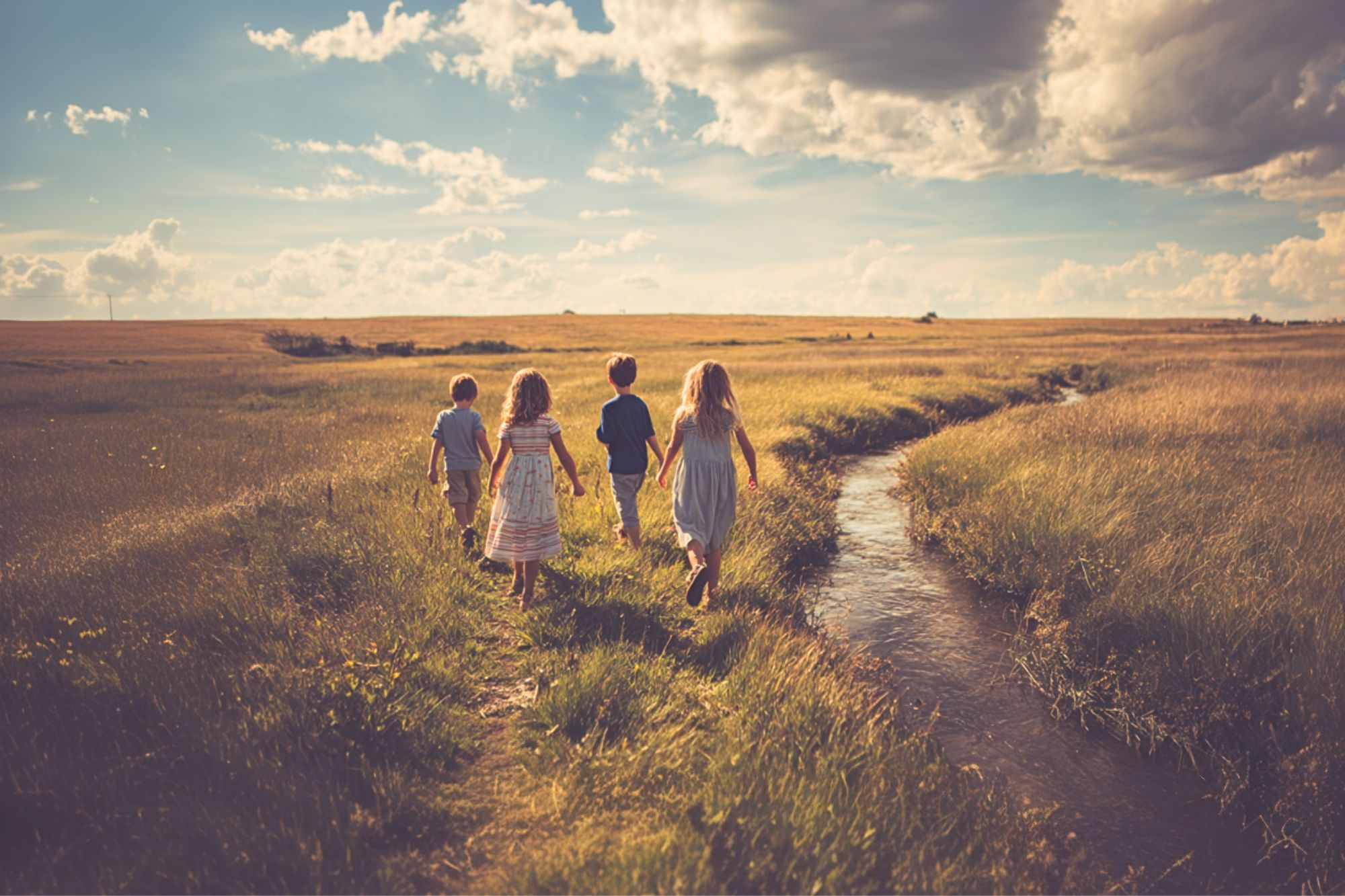
A childhood spent in the great outdoors (including urban green spaces) shapes you in ways you might never have considered. Every scraped knee from climbing trees, every afternoon spent building forts, every moment you chose to explore rather than stay inside has left an invisible mark on who you’ve become.
The mud under your fingernails and the sun on your face during those formative years weren’t just pleasant memories; they were silently sculpting your brain, your emotions, and your entire approach to life.
When children spend their formative years in natural environments rather than confined spaces, the difference shows up decades later in how these adults handle stress, solve problems, and navigate relationships. What emerges is a clear pattern: those who roamed freely outdoors as children develop specific traits that set them apart from their indoor-raised peers. These differences manifest in boardrooms and relationships, during moments of crisis and periods of calm. The outdoors taught lessons that no classroom could replicate.
1. Enhanced mental health and emotional resilience.
Adults who spent a great deal of time outdoors as children often benefit from a natural buffer against life’s emotional storms. Research hints that these individuals experience better mental health as adults compared to those who spent their early years primarily indoors.
Nature has its own rhythm, one that teaches acceptance of things beyond our control. Rain falls when it will, flowers bloom on their schedule, and winter transforms into spring without human intervention. Children who witness these cycles in the flesh develop an understanding that difficulties tend to pass sooner or later.
Your nervous system remembers what peace feels like. Those quiet moments by streams or under trees created neural pathways to calm that remain accessible throughout adult challenges. When anxiety builds or sadness overwhelms, your body more instinctively knows how to find steadiness. A large correlational study from Denmark found that growing up near green spaces led to a lower risk of mental health challenges as an adult.
The outdoors also provided space for big emotions. You could shout at the wind, cry without judgment, or run until exhaustion released frustration. These healthy outlets for emotional expression translate into better emotional regulation as an adult. You learned early that feelings are temporary weather patterns rather than permanent conditions.
2. Superior problem-solving and creative thinking.
Unstructured outdoor play creates minds that think differently. When you turned sticks into swords, built cities from mud, or invented games with nothing but your imagination, you were training your brain to see possibilities everywhere.
Indoor environments often provide predetermined solutions—toys designed for specific purposes, games with established rules, activities with clear instructions. The outdoors offers only raw materials and endless potential. Every fallen log becomes a bridge, fort wall, or balance beam depending on your current need.
Weather changes demand adaptation. Your planned exploration of a dried-up creek becomes a mud sculpture session when rain falls. The hiking trail you wanted to follow disappears under snow, so you create a new route. These constant adjustments develop cognitive flexibility that serves you throughout life.
Children who played primarily outdoors approach adult problems with greater creativity. They’ve learned that multiple solutions exist for every challenge because nature rarely provides exactly what you initially wanted. Resourcefulness becomes second nature when you’ve spent years making something from nothing.
Innovation springs from minds that learned early to work with whatever was available rather than waiting for perfect conditions or ideal tools.
3. Stronger risk assessment and decision-making skills.
Climbing that tall tree taught you something textbooks never could—how to evaluate real consequences. Every branch you tested, every rock you stepped on, every stream you crossed required split-second decisions with immediate feedback.
The outdoors provides honest consequences. Misjudge a jump and you fall. Choose the wrong path and you get lost. Ignore weather signs and you get soaked. These experiences develop intuitive risk assessment skills that transfer to all areas of adult life.
You learn the difference between reasonable risks and foolish ones through trial and error. Most importantly, you discover that avoiding all risk leads to missing worthwhile experiences. The confidence gained from successfully navigating outdoor challenges translates into better decision-making throughout adulthood.
Adults with outdoor-led childhoods often remain calmer during high-pressure situations. They’ve already learned that most challenges can be managed with careful assessment and steady nerves. Fear doesn’t paralyze them because they’ve faced uncertainty before and survived.
4. Greater environmental consciousness and stewardship.
Children form emotional bonds with specific places in nature. You didn’t just play outside—you developed relationships with particular trees, favorite streams, and secret hideouts. These connections create lasting responsibility for the natural world.
Adults who spent a lot of time outdoors in their formative years often make different consumer choices because environmental damage feels personal. They’ve witnessed seasonal patterns, observed wildlife behavior, and developed an intimate understanding of how everything connects.
The urgency many feel about climate change stems partly from direct experiences with natural systems. You’ve seen how delicate these relationships are, how easily they can be disrupted. Conservation becomes natural when you have positive memories tied to specific landscapes.
Career paths often reflect these early values. Children who played extensively outdoors are more likely to gravitate toward environmental fields, sustainable businesses, and green technologies as adults. They pursue work that aligns with their childhood understanding that human wellbeing depends on natural health.
Your connection to nature didn’t end with childhood. You still seek natural environments for restoration and joy because those early experiences established them as sources of genuine fulfillment.
5. Enhanced physical health and body awareness.
Your childhood adventures created a foundation of physical wellness that continues serving you today. Running through forests, climbing rocks, and swimming in ponds developed body awareness that inside activities rarely match.
Natural sunlight during crucial developmental years supported healthy bone development and sleep patterns. Your internal clock learned to sync with natural light cycles rather than artificial illumination. Many adults who had outdoor childhoods report sleeping better and maintaining more consistent energy patterns.
The varied terrain of outdoor environments—uneven ground, hills, rocks, fallen trees—challenged your balance and coordination in ways that flat indoor surfaces cannot. Your proprioception, the sense of where your body exists in space, developed more fully through navigating three-dimensional natural environments.
Perhaps most importantly, outdoor childhoods establish physical activity as natural joy rather than obligatory exercise. Your body learned early to associate movement with exploration and fun. Exercise feels less burdensome when it connects to positive childhood memories of adventure.
Exposure to diverse microorganisms in natural environments is also linked to stronger immune systems. Your body learned to distinguish between harmful pathogens and beneficial microbes, developing resilience that serves you throughout life.
6. Improved social skills and leadership abilities.
Group adventures in natural settings create unique social learning opportunities. When children work together to build forts, explore new territory, or overcome outdoor challenges, they develop cooperation skills.
Natural environments level social hierarchies. Traditional classroom dynamics dissolve when everyone faces the same challenge of crossing a stream or finding the way home. Leadership emerges organically based on current skills rather than predetermined social roles.
Conflict resolution develops naturally when outdoor goals require consensus. Someone wants to go left while another insists on going right, but reaching the destination demands agreement. These negotiations build communication abilities that last a lifetime.
You learned to read not just human emotions but animal behavior and environmental cues. Watching wildlife taught patience and observation skills that translate into better understanding of human nonverbal communication. This broader sensitivity enhances emotional intelligence throughout adulthood.
How many times have you been on a team-building exercises in nature? That’s because they often attempt to recreate what outdoor childhoods provided naturally. Those early experiences of succeeding together in unpredictable environments develop confident, inclusive leadership styles that bring out potential in others.
7. Greater self-reliance and independence.
Independence grows naturally when children learn to navigate environments where parents cannot constantly intervene. Each solo expedition into nearby woods, every challenge overcome without adult assistance, builds unshakeable self-confidence that influences lifelong autonomy.
Outdoor exploration teaches you to rely on your personal judgment and capabilities. When you encounter an unexpected fork in the trail, you must decide which direction to take. No adult can make that choice for you when you’re deep in exploration mode.
Outdoor childhoods often forge adults who believe they can influence circumstances through their own actions. They feel less helpless during difficulties because their formative experiences taught them that persistence and creativity usually lead to solutions. They’ve proven to themselves repeatedly that they can handle more than others might assume.
The confidence gained from successfully navigating real challenges as a child translates into adult resilience. You approach new situations with earned self-assurance rather than hoping others will solve problems for you.
8. Stronger stress management and coping mechanisms.
Exposure to nature during childhood seems to create internal resources that provide lifelong stress relief. Adults who played outdoors extensively know how to find calm when overwhelmed because they learned early where peace lives.
Natural environments restore mental energy that is depleted by modern living. Children who found solace in quiet forest moments or peaceful lakeside afternoons carry this coping mechanism forward. When adult pressures mount, they naturally seek similar restoration.
Mindfulness developed organically through outdoor observation. Watching clouds shift, listening to bird songs, tracking animal movements—these activities trained attention and present-moment awareness long before such skills became therapeutic techniques.
Your nervous system learned to distinguish between real threats and everyday pressures. The outdoors taught appropriate responses to genuine danger while providing perspective on minor frustrations. Many adult worries pale in comparison to being genuinely lost in unfamiliar territory.
Urban stressors affect everyone, but adults with nature-rich childhoods demonstrate remarkable resilience. They’ve developed healthy coping strategies that rely less on substances or destructive behaviors. Natural environments remain reliable sources of restoration throughout life.
9. Improved spatial intelligence and navigation skills.
Three-dimensional thinking develops differently when children navigate complex natural environments rather than primarily flat indoor spaces. Exploring forests, climbing formations, and traversing varied terrain exercises mental muscles that serve numerous adult activities.
Your internal compass strengthened through the repeated need to navigate yourself in and out of environments. Before GPS technology, finding your way required attention to landmarks, the position of the sun, and environmental cues. These skills enhance cognitive abilities far beyond simple wayfinding.
Map-reading abilities, developed through outdoor adventures, exercise spatial reasoning that transfers to many professional contexts. Understanding scale, interpreting symbols, and relating flat representations to three-dimensional reality requires sophisticated mental processing.
Adults who explored diverse outdoor environments during childhood often excel in fields requiring spatial intelligence—architecture, engineering, design, and similar professions. Their minds learned early to visualize complex three-dimensional relationships and manipulate them mentally.
Navigation skills developed naturally through outdoor exploration create confidence in unfamiliar environments. You trust your ability to figure out where you are and how to reach your destination because you’ve successfully done so countless times before.
Your Outdoor Childhood Continues To Shape Your Adulthood
Your childhood spent outside gave you gifts that keep on giving. Each trait developed through those formative years continues to influence your adult experience in countless small ways. The confidence you feel tackling new challenges, the calm you maintain during stressful periods, the creative solutions you generate when others feel stuck—these capabilities trace back to lessons learned under open skies.
Perhaps most importantly, you understand something that indoor-raised individuals often struggle to grasp: humans belong in the natural world. Your nervous system remembers what peace feels like. Your body knows how to find restoration. Your mind retains the flexibility that comes from adapting to environments that cannot be controlled or predicted.
These advantages position you beautifully for navigating an uncertain future. Environmental changes, technological disruption, and social transformation require exactly the adaptive capabilities that outdoor childhoods lead to. Your early experiences prepared you for challenges that didn’t exist when you were young, creating resilience that serves you regardless of what comes next.