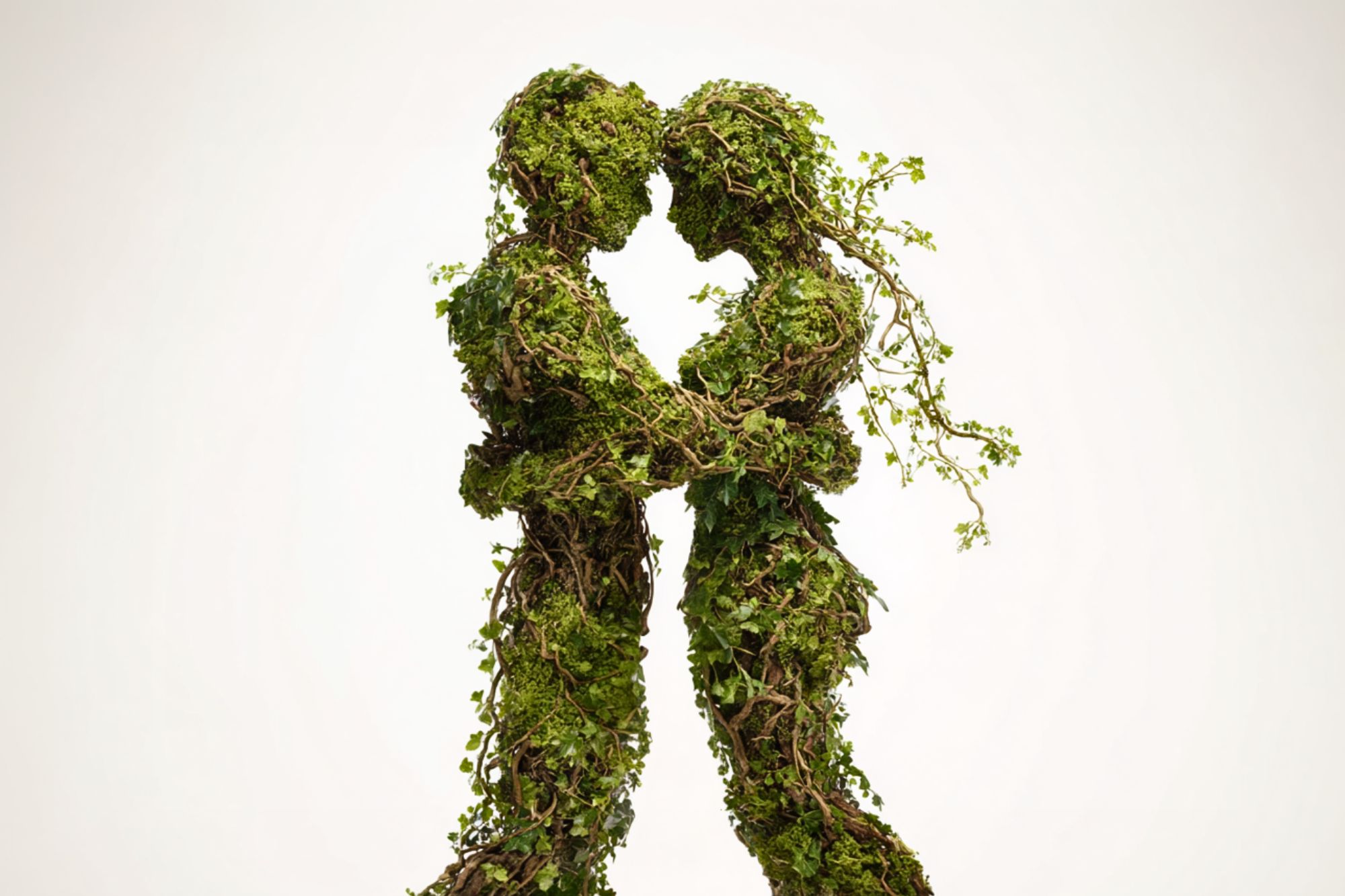
If you’ve ever been in the company of a couple that triggered your “yikes” response, there’s a strong chance they had an enmeshed relationship. The closeness, lack of personal boundaries, and overall unhealthiness of that kind of partnership can make others uncomfortable, and with good cause.
With enmeshment, partners lose their individuality and become a sort of amorphous couple-blob in which each partner is incapable of functioning without the other. The following behaviors are surefire signs that there are few, if any, boundaries between two people in a relationship.
1. Their emotions wholly mirror each other’s.
Not only do enmeshed people feel responsible for each other’s emotions, but they also can’t feel anything other than what their partners are feeling. For example, if a person’s partner is feeling unhappy, they can’t take joy in anything they themselves experience. It’s as though they don’t think they have the right to feel anything other than exactly what their partner is experiencing.
This often happens to individuals whose emotions were invalidated when they were children, or who were taught that other people’s feelings mattered more than their own. As adults, they may have difficulty recognizing their own emotions, let alone allowing themselves to feel them. As such, they place a priority on making their partners happy, because then they’re “allowed” to share in that happiness too.
2. They’re always in each other’s pockets.
People in enmeshed partnerships are rarely far from one another. Furthermore, they rarely have any pastimes or pursuits of their own. Instead, they set aside all the things they used to love to do and took up whatever their partners were into.
These individuals may have had a wide range of hobbies and interests when they were younger, but they abandoned them all in favor of sharing those of their partners. Seemingly overnight, they might have gone from being avid crafters, readers, or science aficionados to cyclists, gamers, and movie buffs.
3. They have no opinions or preferences of their own.
I have a lovely friend who has a terribly enmeshed relationship with her intensely narcissistic partner. A few years ago, we were looking at photos together, and she joked about having had the exact same hairstyle for over 20 years. I asked her if she ever thought of changing it, and if so, what would she get instead? She responded by telling me that her partner likes her hair long, red, and silky.
Fair enough, but I asked her whether that’s the hairstyle that she liked. She looked at me as though I were quite mad, and said that she likes to make him happy. Conversations about her wardrobe have gone the same way: she has zero preferences outside of what he likes her to wear.
This type of behavior is common in enmeshed couples: their personal needs and desires become inextricable from those of their partners. They simply aren’t individuals with their own preferences anymore.
4. They don’t trust each other unless they can see each other.
Many enmeshed couples expect to always have access to one another, regardless of what they’re doing. This often happens when one or both of them are terribly insecure and feel that unless they’re able to observe each other at any time, they’ll get up to something nefarious.
Even if they’re using the washroom or taking a bath, they’re expected to keep the door unlocked so the other person always has access to them. Furthermore, they fully expect to be able to check each other’s phones and emails at all times, and be present during phone conversations so that they’re active participants in everything that’s going on.
5. They have no social life without each other.
If a couple seems to be attached by an unseen umbilical cord, i.e., they’re never apart, have to do absolutely everything together, and have no separate friends of their own, that’s a solid sign that they’re enmeshed.
You could invite one of them to a baby shower where only women will be in attendance, and their male partner will show up with the expectation of joining in. Similarly, there may be an “immediate family only” event like a will reading, and their partner will be there too, even though it was expressly stated that they weren’t invited. If they can’t show up as a package deal, then neither is likely to attend.
6. They’re controlling each other under the guise of care.
Enmeshed couples usually see each other as extensions of themselves, which is why they can often be controlling towards one another with regard to personal choices and behaviors. They may also seek to control each other’s emotions, either passively or overtly.
Most of this is done under the guise of care, where they’ll insist that they’re “just trying to help.” This “help” was never asked for, of course, and usually involves something that benefits the one who’s being controlling in some way.
7. They always have to ask each other permission before doing a thing.
It’s one thing to ask a partner’s permission to go into their bag, or if it’s okay to eat the last bagel in case they’ve been saving it for lunch the next day, and something completely different if you’re expected to ask permission to go spend time with friends and family. Now, this isn’t the same thing as checking with your partner whether it’s convenient because you have kids together, or to make sure you don’t have joint plans already booked. That’s normal and respectful.
But those things aside, in a healthy relationship, one partner might inform the other that they’ll be seeing a friend for lunch the next day, or that there’s a family gathering coming up on X date. In contrast, in an enmeshed relationship, permission has to be asked for and granted, without good reason. Furthermore, it’s not uncommon for permission to be rescinded if something that’s deemed more interesting or important comes up.
8. They believe that “outsiders” are intent on breaking them up or interfering.
It’s common in enmeshed relationships for one or both partners to believe that spending time alone with other people will result in a breakup. In their minds, “outsiders” are terribly envious of their partnership, and will try to part them by any means possible — either to spite them, or because they want to be with one partner or the other.
This usually results in a fair amount of isolation. The partners may become recluses, rarely leaving the house unless it’s for work, though they may try to work remotely whenever possible. Furthermore, they’ll curb any questions about their relationship and will back away from any friendships that threaten to get too close.
9. Simultaneously serving and resenting each other.
One key trait of enmeshment is serving the other person to the point of self-sacrifice. It usually involves the partner with lower self-esteem going above and beyond to make their spouse happy, even if it means sacrificing their own well-being to do so. Though the behavior may be caring, it’s often driven by a fear of abandonment rather than the actual desire to serve.
Because of this, the partner who’s throwing themselves under the bus repeatedly will often eventually become resentful of their partner’s needs, but will then fiercely defend their self-destructive behavior as well as their spouse’s demands if anyone dares to question them.
Final thoughts…
One of the most frustrating and upsetting things to experience is when someone you care about is in an unhealthy, enmeshed relationship — especially with a narcissist — and you can’t do anything about it. They’ll refuse to listen to you if you try, and may accuse you of trying to break them up for your own benefit.
If someone you love is in a relationship that has zero healthy boundaries, all you can really do is be as supportive as you can and be there for them when the relationship eventually fails, and they need you.