
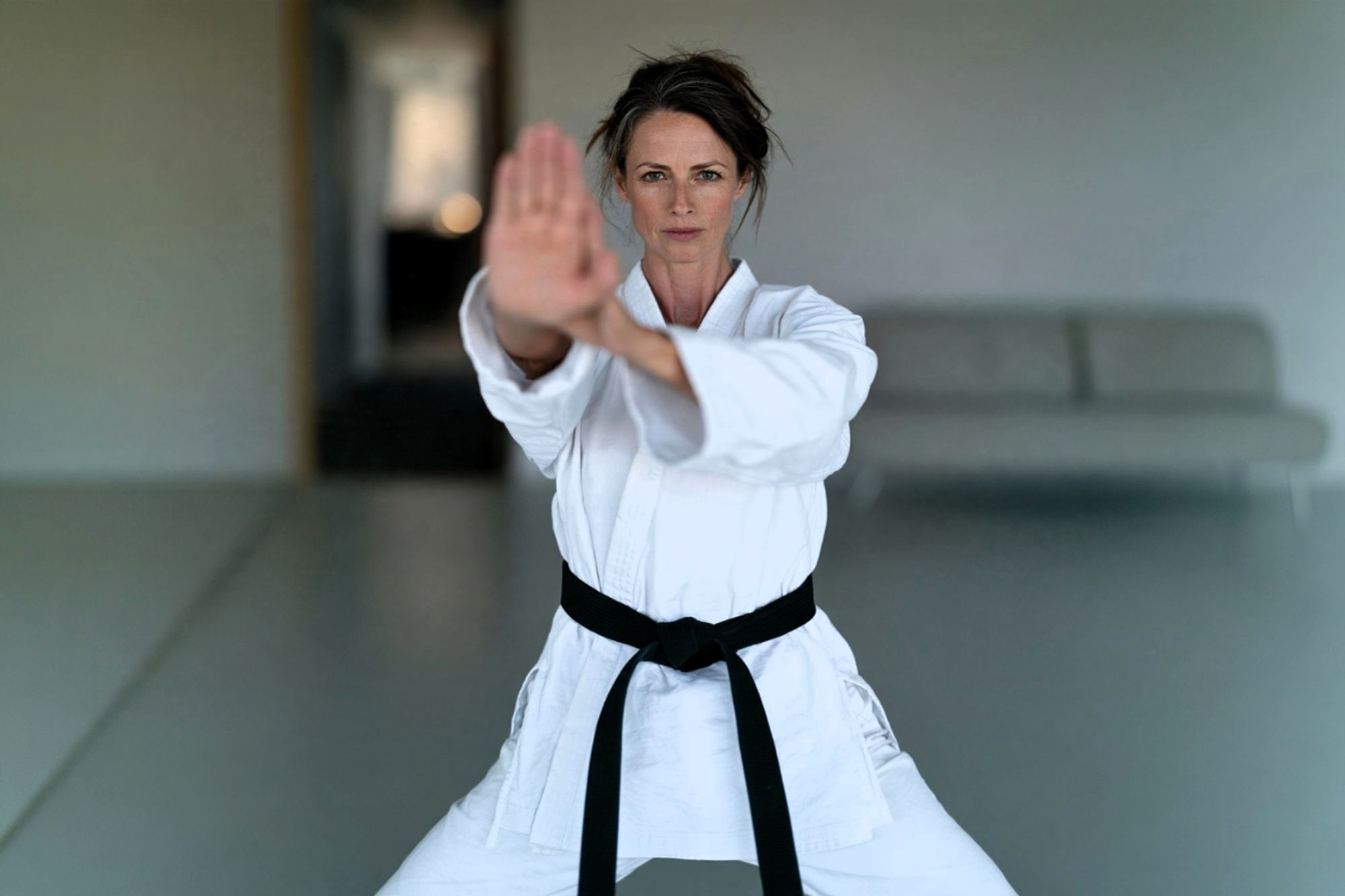
One of the first things that people are taught when they start martial arts training is that its core tenet is mastery of the self. Bruce Lee extolled this by teaching his students that martial arts are more about conquering our own fears, impulses, and limitations than they are about conquering opponents.
As a result, the strategies that martial arts classes teach can help us in countless different areas of our lives, including when something happens that throws us off balance. Here are just some of them.
9 martial arts strategies that can help keep you steady when life throws you off balance:
1. “Before enlightenment, chop wood, carry water. After enlightenment, chop wood, carry water.”
Although this is a Zen Buddhist saying about spiritual enlightenment, it’s one that’s used by many martial arts practitioners as well.
In fact, I first came across it when learning Karate. My sensei at the time was talking about the importance of maintaining one’s training schedules in good times as well as bad, and referenced this particular saying as an example.
When times are tough, maintaining the rhythms of physical training and supply gathering doesn’t just ensure that you remain capable, warm, and fed — the routine can help you to maintain personal peace and calm in even the most challenging circumstances.
What’s more, my sensei’s take was that if you remain strong and well-trained in times of peace, and you keep stocking up on essentials (like wood and water), you’ll have those to draw upon during times of difficulty.
2. Flow with intention.
Morihei Ueshiba, who founded Aikido, taught us that it’s better to redirect energy than to fight against it.
You might have come across this principle in practice if you’ve been swimming in a river that had a strong current. If you felt that you were being pulled downstream and started to panic, you knew that it was best to flow with the river and angle yourself towards the shore, rather than flailing against that current and exhausting yourself to no avail.
This approach works well in relationships and business as well as with self-defense and personal preservation. Instead of butting heads in a negotiation or an argument, find middle ground or something that matters to that individual, and determine how you can work together for everyone’s benefit.
3. End the fight before it starts.
Or in other words, by anticipating potential issues or conflicts, you can avoid a bad situation before it even starts.
This is the core philosophy behind Jeet Kune Do, which means “Way of the Intercepting Fist” — created by Bruce Lee.
Lee talked about intercepting your opponent’s attack or neutralizing threats so early that physical altercations become unnecessary, as in the famous “art of fighting without fighting” scene in Enter the Dragon.
Lee drew from Wing Chun, Western boxing, and fencing for his martial arts forms, while many traditional Chinese martial arts drew heavily from the animals that people observed.
For example, they noticed that cranes can stand still for long periods of time until the correct time to strike revealed itself, and snakes rely on precise, well-timed strikes to vulnerable spots rather than trying to overpower their opponents.
In practice, this means that when trying to achieve something, focus on both your objective and anything that may impede progress towards it. Then eliminate those impediments as quickly and effectively as possible.
Similarly, if someone is behaving poorly towards you, defuse the fight with conversation and misdirection before it gets heated, rather than trying to throw them over a table.
4. Nothing hits harder than the floor.
This is a maxim that my Judo instructor taught us that he adapted from Judo’s founding principle, seiryoku zen’yō (“maximum efficiency, minimum effort”). It essentially teaches that it’s best to aim for the greatest possible result with the least amount of effort.
In martial arts, for example, dropping an opponent to the floor takes less effort than fighting while standing. But this approach can also work tremendously well when life throws you off balance.
For example, when something unexpected occurs, aim to eliminate as much friction and drama as possible, and avoid anything you can’t immediately control.
Do high-focus tasks when you have bursts of energy, and use downtime to rest deeply instead of trying to stay busy just to self-soothe with hollow productivity.
5. In stillness comes understanding.
Tai Chi is a martial art that seeks “motion in stillness, and stillness in motion.” It teaches practitioners to find a strong state of inner calm and stillness by rooting their bodies, regulating their breath, and quieting their minds with slow, intentional movements.
When you move slowly and gracefully, your breath naturally slows and calms down, and you feel incredibly grounded.
This groundedness allows you to perceive things as they are instead of reacting impulsively due to panic or anger.
And as your practice deepens, you can attain this level of stillness not just in a quiet room while meditating, but all the way up to crisis situations.
For example, if your child falls and breaks their leg, you can soothe them with calm stillness while also getting them the medical attention they need, without falling apart in the process.
Instead of reacting emotionally, you’re training yourself to respond decisively to achieve the best possible result.
6. We only practice balance when we’re shaken.
Have you watched the film Crouching Tiger, Hidden Dragon? If so, you might remember the scene in which Li Mu Bai and Jen Yu were fighting on tall bamboo plants. When the wind blew, Li Mu Bai flowed with the bamboo’s movement and found his balance accordingly.
He was using Wudang principles to show how finding balance in any situation can allow you to negotiate whatever life throws at you.
Obviously, this was a choreographed wire-work fiction, but the key takeaway here is that balance is only needed (and found) when we’re shaken. If you’re standing still on solid ground, you’re not putting effort into balance — consciously or unconsciously.
It’s only by regularly putting yourself in situations where you’re slightly off balance that you can develop better proprioception (your body’s sense of where it is in space) while staying aware of whatever is going on around you.
Similarly, in everyday life, if you regularly step out of your comfort zone or get used to sitting with discomfort in small, manageable ways, you’ll get better at regaining your footing when life knocks you sideways.
7. Self-discipline is the path to true achievement.
This can also be referred to as “no pain, no gain,” though it’s more about consistency than suffering.
It’s easy to skip training when you’re feeling a little tired, or you’re having a bad day. After all, you can always make up for the lost time later, right?
Only maybe there’s another excuse next time, and so on. Instead, the most skilled martial artists are the ones who consistently show up and put the effort in, even if it’s only small, regardless of ennui or personal frustrations.
A friend of mine who practices Muay Thai is very fond of this saying, and tries to instill in his own students the truth that nothing good comes without sacrifice.
To attain a high level of skill in any physical discipline, you must endure and push yourself hard to get there, sometimes when you don’t feel like it.
Furthermore, forcing yourself to show up because you gave your word to both yourself and your instructor that you would can help you build a rock-solid work ethic. This will affect your personal relationships as well as your professional life and physical training goals.
Of course, there are times when you genuinely can’t and shouldn’t push through, such as when you’re injured, ill, or running on empty.
A good rule of thumb to tell the difference is to ask yourself whether you’ll feel better or worse for having shown up. Simple ennui or resistance usually fades once you get started, while real exhaustion or pain tends to get worse.
8. Stay as calm in a crisis as in daily life.
Heijoshin, which translates to “ordinary mind,” is a foundational principle of many Japanese martial arts.
It encourages the practitioner to maintain a state of complete calm regardless of what situation might unfold, rather than dwelling on past actions or potential difficulties. All that matters is where you are right here and now, responding to whatever happens next.
Mastering this allows people to handle difficult circumstances as gracefully and easily as making a cup of tea.
You can cultivate this kind of present-moment focus by doing a regular meditative practice that encourages mindfulness, but crucially, you can practice it during life’s small irritations such as a traffic jam or an enraging email.
Treat each one as an opportunity to notice your reaction, take a slow breath, and then respond as calmly as you would on a good day.
By establishing this strong foundation of calm, you can navigate even the most difficult situations with courage and steadiness.
9. Build resolve by leaning into discomfort.
In the early 1700s, a Zen monk and former samurai named Yamamoto Tsunetomo dictated his thoughts to a younger samurai, Tashiro Tsuramoto, who recorded and compiled them in a book called The Hagakure.
It’s both a practical and spiritual guide for warriors, and its tenets include leaning into adversity and strife rather than huddling away from discomfort.
One of the teachings therein involved encouraging the reader to envision all the possible injuries and deaths that they might experience. By thinking of these clearly and imagining how they might play out, they would be better prepared for whatever situation led to their last moments on Earth.
Though the book is considered somewhat controversial (its extreme philosophy on death and loyalty has often been reinterpreted to promote blind obedience and militarism), it’s original interpretation can be used to help us remain steady when life throws us off balance.
For example, like rehearsing potential responses to conflicts ahead of conversations, so you’re more comfortable when they happen. You can also envision how you’d deal with your basement being flooded, or what to say if your mother-in-law insults your new wallpaper.
Though it’s important not to get lost in spiraling what-if scenarios, by bracing yourself for likely ones, you can respond more efficiently when crisis situations occur.
Final thoughts…
There are hundreds of different martial arts from around the world, all of which can be incredibly beneficial to their practitioners.
If you’re interested in pursuing some of them, try out a variety of different approaches to see which one(s) appeal to you the most and which offer you the best solutions to the situations you’re trying to navigate.
In addition to helping you strengthen your body, they can also offer you the helpful strategies we’ve discussed here for strengthening resolve and remaining steady when life inevitably throws you off balance.