I used to be the “yes” friend. The one who’d show up to your birthday drinks, your housewarming, your colleague’s leaving do. I’d arrive with wine, stay till close, and wake up the next morning with a stinking hangover, contemplating my behavior, but assuming this is what life was supposed to look like.
Except somewhere between my mid-thirties and now, the performance became both apparent and impossible to sustain. What I discovered was someone who’d always been a bit hermit-shaped, just very well disguised. And if you’re here, reading this tale, there’s a good chance that the same can be said for you.
Stage 1: The “yes to everything” era.
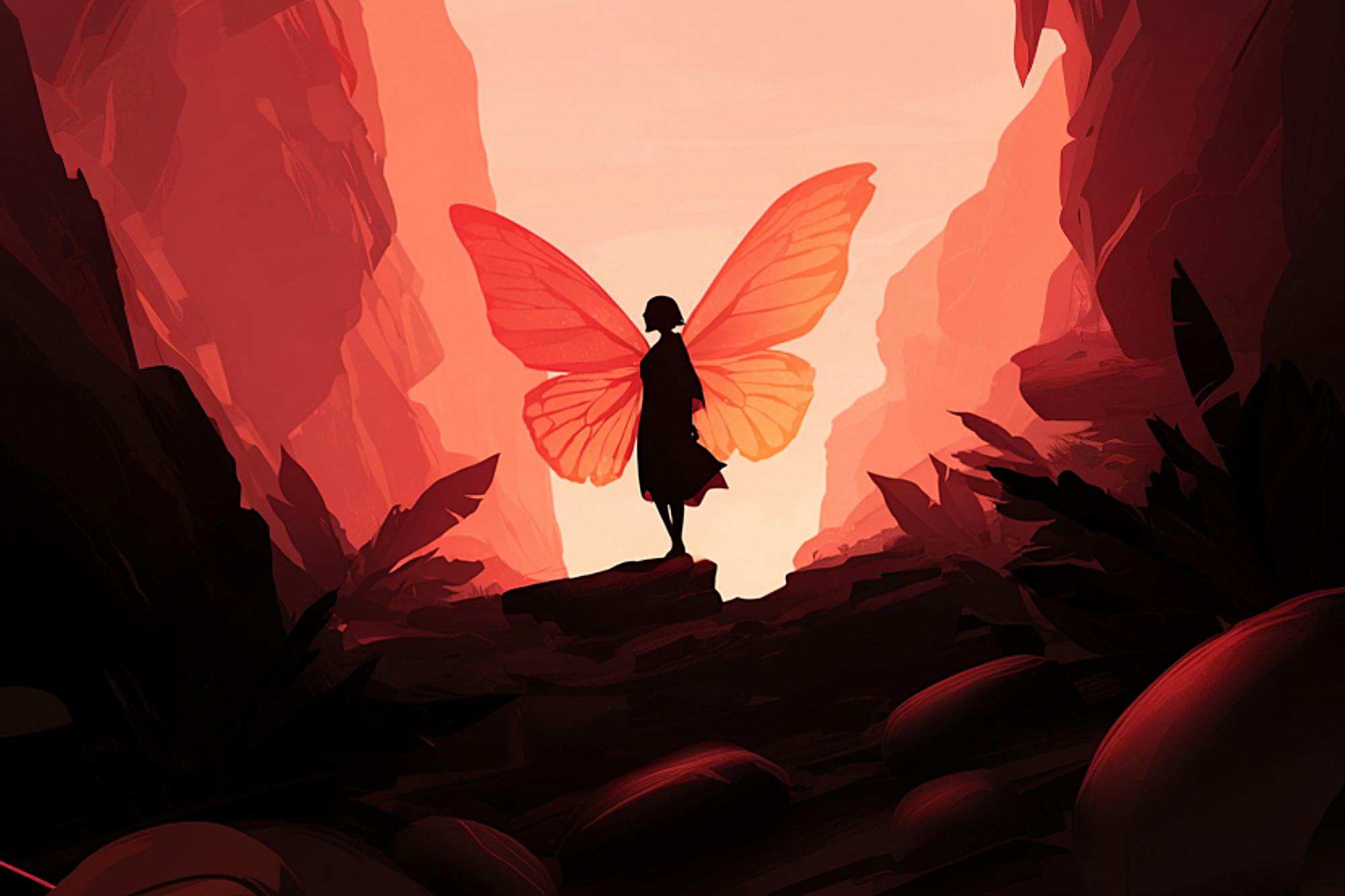
Let’s start at the beginning, when the butterfly wings were still firmly attached, and I was flying with what looked like effortless enthusiasm.
In my twenties and early thirties, my calendar was a Tetris game of social commitments. And the thing is, it didn’t feel exhausting then—or rather, the exhaustion felt like the natural cost of living a full life.
Maybe you remember this version of yourself, too—the one who said yes automatically, who measured your worth by how full your social calendar was, who genuinely believed that being busy meant you were living correctly.
Perhaps, like me, you learned early that alcohol was the key to unlocking the version of yourself that people seemed to prefer. At 13, I discovered that a few drinks could dissolve the static of social anxiety and would transform me from the girl who overthought every interaction into someone who appeared confident, funny, and spontaneous.
By my twenties, I’d perfected the persona: turn up with a couple of drinks already inside me, have a few more drinks, and suddenly you’re the life of the party. Or at least, you’re passing as someone who belongs at parties.
Looking back, I can see the cracks even then. As a child, I’d been sociable in bursts—happy to play with friends, but equally content spending hours alone, lost in my own world. I needed those long stretches of solitary play to recharge. But somewhere along the way, I learned that being social was the currency that mattered, the thing that made you valuable and wanted.
So I said yes. To everything. Even when every cell in my body was whispering please, no, I just want to stay home. The FOMO was real and relentless. If I wasn’t there, I’d miss the inside jokes, the bonding, the proof that I was someone people wanted around. The FOMO felt more threatening than the exhaustion of showing up.
Stage 2: The first cracks of overwhelm appear.
Something shifted in my mid-thirties. Or maybe it didn’t shift—maybe the mask just started slipping because I no longer had the energy to hold it in place.
Having kids changed everything. Not in the expected ways—the sleepless nights, the constant demands, the identity shift of becoming someone’s mother. Those were hard, yes, but manageable. What I wasn’t prepared for was how pregnancy and the physical toll of caring for small children would trigger something deeper, something that had been lurking in my body all along.
My chronic pain started 3 months after the birth of my first child and never really stopped. What I didn’t know then—what took years to diagnose—was hypermobile Ehlers-Danlos Syndrome (hEDS). The condition is genetic, but carrying and caring for children pushed my body past its breaking point.
But it wasn’t just the physical toll. Having kids obliterated whatever social energy I had left. I was touched out, talked out, and peopled out by the end of every day. The idea of then making conversation with other adults, of performing “normal”—it felt impossible.
This is common for parents, especially mothers, especially those of us navigating undiagnosed or newly diagnosed health problems triggered by pregnancy and childbirth. Your body changes in ways that go far beyond the obvious. Your capacity shrinks. Your reserves disappear.
For a while, I could push through, though. With a few drinks, I could still access that sociable version of myself. The wine would smooth the edges, quiet the anxiety, and make small talk feel less like pulling teeth. But the performance was becoming more obvious to me, even if no one else seemed to notice.
If you’ve ever needed a drink (or two, or three) just to feel “normal” in social situations, you might recognize this. Not necessarily problem drinking, but using alcohol as a social prosthetic—the thing that bridges the gap between the person you actually are and the person you need to be to get through the evening.
But I started needing more “recovery time” after even tame social events. Like many people in middle age and beyond, I just couldn’t tolerate alcohol and late nights anymore. So I stopped drinking.
This was probably the biggest turning point for me. I discovered that without alcohol, I couldn’t push through social events anymore. Now sober, I felt every awkward pause, every forced laugh, every moment of pretending to be more interested in the conversation than I actually was.
Stage 3: Cancellation begins.
If you’ve ever crafted a carefully worded excuse that’s technically true but functionally a lie, you’re in good company. For some reason, we’re taught that “I don’t want to” isn’t a socially acceptable reason, so we create cover stories that sound more legitimate.
As such, the relief that comes when you do have a legitimate excuse is almost intoxicating. A cold? A work deadline? A family obligation? Thank god. You can say no without shame, without having to explain that the real reason was simply: I don’t have it in me.
For those of us who spent years as people-pleasers, this stage is particularly uncomfortable. Because we’re not just canceling plans—we’re dismantling a carefully constructed identity as the reliable, fun friend, the one who shows up, the one people can count on.
I’d stare at the group chat, watching messages pile up about get-togethers, typing and deleting responses, trying to land on something that sounded legitimate but not dramatic. Hit send, feel immediate relief, followed promptly by guilt.
And yet, the relief always outweighed the guilt. That probably should have told me something.
Stage 4: The great friendship clear out.
If you’ve ever had to mentally categorize your relationships into “worth the energy” and “too costly,” you know how ruthless this phase can be. And how necessary.
For me, a hierarchy developed, mostly unconscious at first, then increasingly deliberate: immediate family, closest friends, everyone else could wait. Or not happen at all.
But even within my closest relationships, I was making calculations. Some friends were easy—low-maintenance and understanding. Others required more performance: more energy, more “on,” more pretending I was the version of myself they expected.
And this is where the people-pleasing unraveling really began. Because the friends who required the most performance weren’t necessarily bad people or bad friends—they just didn’t know the real me. They knew the version I’d been presenting for years: sociable, available, up for anything. Pulling back meant exposing that this person had been, at least partially, a fabrication.
This is especially common for women in midlife and beyond, and the reasons are myriad. Perimenopause, undiagnosed neurodivergence, accumulated burnout, and the dawning realization that life is too short to spend it performing can be incredibly revealing. You start getting very clear about what’s actually worth your diminishing energy reserves. Perhaps you’ll recognize this as the phase where you suddenly run out of damns to give.
For many people, myself included, this shift from “I should go out” to “Why should I go out?” is seismic. This is the point where a lot of people stop making excuses. They simply say, “I won’t make it, but have fun,” instead of crafting elaborate cover stories. The honesty can be both terrifying and liberating in equal measure.
Some family members commented on the dramatic change in my socializing and suggested it was just a phase, and that once the kids were older, I’d want to get out there again. But I knew differently. I’d spent a lifetime pretending. And I was over it.
I couldn’t do it anymore. Didn’t want to. And for the first time, I was allowing myself to stop trying.
Stage 5: The identity crisis.
If you’ve experienced a major identity shift in your thirties or forties—whether from illness, sobriety, parenthood, realizing your undiagnosed neurodivergence, or simply aging—you know this particular brand of grief. Mourning not who you were, but who you thought you were.
I started to question: had I ever been that person? Or had I just been very, very good at pretending?
This is where stopping drinking became impossible to ignore as a factor. I’d catch myself thinking “I used to be fun” and then wonder: was I fun, or was I drunk? Was I outgoing, or was I anxious and overcompensating? Did I love socializing, or did I love the version of myself I became after a few drinks? Was I becoming a hermit, or was I finally letting my natural hermit-shaped self emerge after years of forcing a square peg into a round hole?
I didn’t know. Still don’t, really.
For anyone who’s stopped drinking and found their social life completely unraveling, this is likely a familiar story. You realize how much of your “personality” was actually just disinhibition and that many of your friendships were built on shared drinking rather than actual connection.
The uncertainty I felt was deeply uncomfortable. Because if this was who I’d always been, it meant I’d spent decades performing. And if this was something new, something broken, it meant I’d lost a part of myself.
Neither option felt good.
Stage 6: The permission to be yourself.
Around this time, several of my close relatives were diagnosed with autism and ADHD. So I started learning about neurodivergence in order to support them, and I soon came across a lot of information about how autism, ADHD, and the combination (AuDHD) present differently in girls and women, in large part because of something known as autistic masking.
Reading about autistic burnout, the cumulative cost of masking, and the conflicting needs of the AuDHD profile made something click into place. I haven’t pursued a diagnosis, but these patterns certainly resonated with me and gave me something I’d never had before: permission to honor my actual needs instead of forcing myself to be someone I wasn’t.
It’s an increasingly common experience. Many women, in particular, are discovering or suspecting neurodivergence in their 30s, 40s, and beyond, often when they have kids, or hit perimenopause—anything that strips away the coping mechanisms that kept the mask in place. Suddenly, the traits they’ve been explaining away their whole lives have a name, a pattern, a context.
Now, of course, not everyone who discovers a preference for their own company later in life will do so because of neurodivergence. There may be countless reasons why you feel this way now: accumulated burnout from decades of people-pleasing, the natural introspection that comes with aging, being raised in a culture that celebrates extroversion when you’re naturally introverted, chronic illness that’s limited your capacity, hormonal changes that shift your tolerance for stimulation, or simply the clarity that comes from finally knowing yourself well enough to admit what you actually want rather than what you think you should want.
Whatever the reason, the realization is the same: you’re not broken for preferring solitude. You’re finally listening to what you need.
Stage 7: The loneliness paradox.
Now, all of this self-discovery was well and good, but the thing I learned about choosing solitude is that you can still be lonely even when you choose it. Especially when you choose it. Because the reality for most of us is that we’re wired for connection even when connection exhausts us. It’s a cruel joke, really.
I’d scroll through social media and see evidence of life happening without me. Friends at dinners, celebrations, and spontaneous gatherings. And I’d feel this complicated knot of emotions: relief I wasn’t there (because I genuinely wouldn’t have enjoyed it), but also a weird sadness at being so separate from it all.
Yes, there is a difference between solitude and isolation, but the line between them is thinner than I’d realized. Solitude is restorative—chosen time alone that refills your cup. Isolation is depleting—a separation that starts to feel like disconnection. But it was so easy to cross that line without noticing.
Of course, the chronic illness didn’t help. Pain and fatigue are isolating by nature—they put you in a different reality from healthy people, make it harder to relate, harder to participate, harder to explain why everything costs so much more energy than it should.
But even if you don’t have a chronic illness, you might recognize this too—that moment when you realize your carefully constructed hermit life has become a bit too small. For me, the paradox was maddening: I didn’t want to go out, but I missed the connection. I didn’t want to socialize, but I felt lonely. I’d carefully constructed this life that protected my energy and honored my limitations, and yet something was missing.
So I was caught between wanting deeper connection but not having the capacity for it. Needing people but finding most people exhausting. Lonely in the solitude but depleted by socializing.
This is perhaps the most frustrating stage—when you realize there’s no simple solution. When both staying home and going out feel wrong in different ways. When the life you’ve created is both exactly what you need and not quite enough.
Stage 8: Finding the balance (or not, as the case may be).
So here I am now. Not quite a hermit, not remotely a butterfly. Something in between, though the balance is precarious and I’m never quite sure I’ve got it right.
If you’re reading this and thinking, “I don’t know which stage I’m in or where I’m headed”—welcome to the club. Most of us are figuring it out as we go, making adjustments, swinging between extremes, trying to find something sustainable.
I’m not returning to the “yes to everything” era—that person is gone, and good riddance. But I’m trying to find a version of connection that doesn’t destroy me. That involves firm boundaries. I leave when I need to leave. I don’t apologize for my limitations. I’m honest about my capacity. “I can do two hours” is a complete sentence. So is “I’m at my limit, I need to go home now.”
Setting these boundaries is terrifying at first, especially if you’ve spent your life people-pleasing. But for many people, they’re the only thing that makes socializing sustainable. Without them, you’re back to performing and paying for it for days afterward.
Some relationships have survived this new version of me. The friends who get it, who don’t take it personally, who are happy to meet me where I am. Those are the ones I’m actively nurturing now—not out of obligation, but because I genuinely want them in my life, just in smaller, more manageable doses.
Others fade, and you have to make peace with that. Not everyone wants a friend who can only show up in two-hour increments, who cancels when they’re depleted, who can’t do spontaneous or late nights or big groups. And that’s okay. It has to be okay.
So this is where I am now: living a carefully boundaried life that protects my energy and honors my limitations, but also feels… a little small. Limited. Like I’m missing something I can’t quite access.
But maybe this is just what it looks like to be a hermit-shaped person trying to live in a world built for butterflies.
Maybe the goal isn’t to figure it all out, but to keep showing up for the connections I can manage, while being honest about the ones I can’t.
Maybe it’s okay to want more connection while accepting that I don’t have the capacity for it. Maybe it’s okay to still be figuring this out.
Maybe it’s okay to be neither butterfly nor full hermit, just someone who’s doing their best with the brain and body they’ve got.
The part where I don’t wrap it up neatly…
I could end this with some wisdom about finding balance, or embracing your true self, or how it all worked out in the end.
But that would be a lie.
The truth is messier: I’m still in it. Still negotiating. Still trying to figure out how to be a person who needs a lot of solitude but also needs some connection. Still working out what’s realistic given the chronic illness, the perimenopause, and the traits that make socializing harder than it is for other people.
You might still be in it, too. Still figuring out where you land on the spectrum between butterfly and hermit, still adjusting your boundaries, still struggling with the loneliness paradox, still not entirely sure if you’re honoring yourself or just hiding.
That’s ok.
It’s okay to not have it figured out. It’s okay to want things you don’t have the capacity for. It’s okay to be exactly where you are on the timeline, wherever that is.
If you’re reading this and thinking, “This is me, but what do I do about it?” I’m sorry, I wish I had a tidy answer. But I don’t. What I have for you instead is solidarity.
I see you. I’m right there with you. Still figuring it out, one declined invitation at a time.