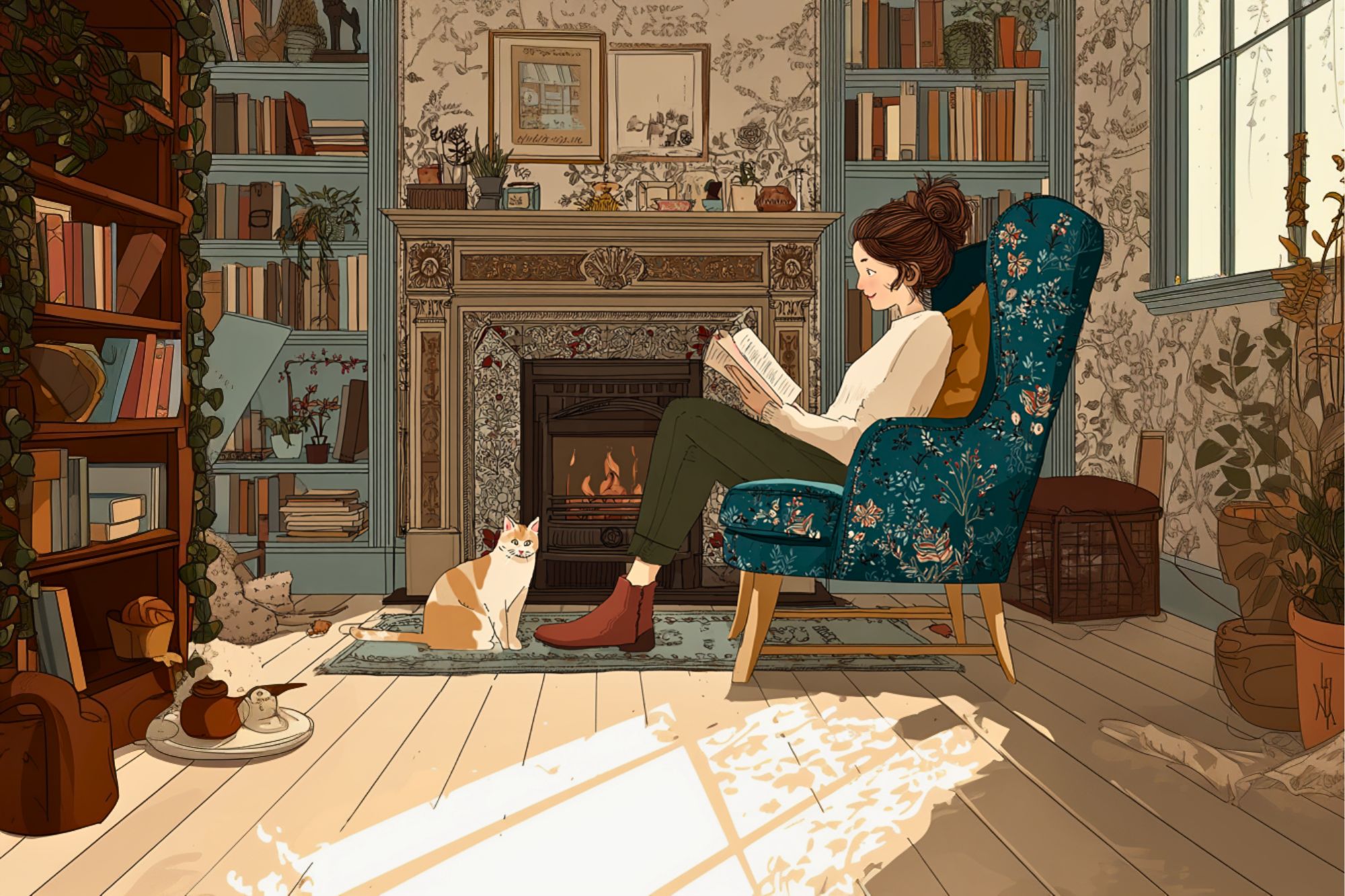
Choosing a hermit lifestyle takes courage in a world that insists you need constant connection to be whole. Society tells you that stepping back means missing out, that solitude equals loneliness, and that a full calendar provides a full life.
But what if the opposite were true? What if the path to genuine peace, deeper work, and authentic living runs through periods of deliberate isolation? What if protecting your energy, attention, and time requires you to close the door on a social world that makes constant demands of you? The hermit life isn’t retreat—it’s reclamation. And for those brave enough to try it, even temporarily, the benefits extend far beyond what you might imagine.
1. You become immune to users, abusers, and energy vampires.
Every social circle has them. The friend who only texts when they need something. The person who turns every conversation back to their drama. Someone who uses guilt like a weapon, making you feel selfish for having boundaries.
Social norms trap you with these people. You’ve known them for years. They’re going through a hard time. You don’t want to seem mean. Meanwhile, they drain you completely, taking advantage of the fact that cutting someone off feels harder than enduring their behavior.
Hermit life solves this completely. No social access means no way in for toxic people. They can’t gradually push your boundaries. They can’t use mutual friends as leverage or trap you in relationships you’ve already outgrown. Your door stays closed, and with it, every manipulation tactic that relies on social proximity loses its power. When you choose solitude, you’re choosing safety from people who see your kindness as weakness.
2. You dramatically reduce anxiety and mental exhaustion.
Your brain works incredibly hard during social interactions, even pleasant ones. Reading facial expressions, managing how you come across, deciding what’s safe to say and what needs filtering—all of this happens simultaneously, constantly.
“Social hangover” describes a real neurological phenomenon. After extended time with others, many people feel completely wiped out, needing hours or days to recover. For introverts and neurodivergent people, especially, social situations don’t energize; they actively drain.
Each interaction triggers your body’s stress response. Your nervous system stays alert, monitoring threats and managing impressions. Cortisol levels rise and often stay elevated long after you’ve returned home.
Hermit-like periods give your system permission to rest. Without the cognitive load of constant social navigation, your baseline anxiety often drops dramatically. The exhaustion you thought was just part of life starts to lift, revealing how much energy you’d been spending on simply being around people. Some people discover they weren’t naturally anxious at all—they were just overstimulated.
3. You discover your authentic self without social performance.
Right now, you’re performing. We all are. The version of yourself you present to colleagues differs from the one your family sees, which differs from the one you show friends. Each audience gets a slightly edited version, carefully managed.
Constant social feedback shapes who you become. Over years, you adopt beliefs that aren’t really yours, preferences that match your group, values that seem expected. The performed self gradually overtakes the authentic one until you can’t tell the difference.
Carl Jung understood that individuation—becoming truly yourself—requires solitude. Without an audience, the performance ends. You can question everything you thought you believed.
Hermit periods reveal uncomfortable truths. Activities you claimed to enjoy might bore you without the social element. Personality traits you considered fundamental might be entirely performative. Interests you thought were genuine might have been chosen for social acceptability. These realizations hurt, but they also liberate. Who you actually are matters more than who you’ve been pretending to be.
4. You are free from drama, gossip, and interpersonal conflict.
Social networks generate friction. Put any group of people together long enough and politics emerge. Jealousies develop. Misunderstandings multiply. Someone always feels slighted, excluded, or misunderstood.
Even genuinely positive relationships demand ongoing maintenance. Conflicts need resolution. Hurt feelings need attention. You navigate one person’s divorce while managing another’s job stress while avoiding topics that upset a third person. The mental space this occupies is enormous.
Hermits remove this entire category of stress. No relationships means no relationship problems. No one’s feelings to hurt. No sides to take in others’ conflicts. No emotional labor spent maintaining peace in a group.
The relief can feel almost physical. That background hum of social anxiety—did I say the wrong thing, is she mad at me, do I need to smooth this over—simply stops. Your mental real estate becomes your own again.
5. You eliminate secondhand stress from others’ problems.
Stress spreads like a virus. When your friend vents about their terrible boss, your body responds as if you’re being threatened. Your cortisol spikes. Your heart rate increases. Mirror neurons make their stress your stress.
Research on stress contagion shows that simply hearing about others’ problems triggers genuine physiological stress responses. The worries of everyone in your life—their relationship drama, financial troubles, work conflicts, health scares—all become low-level background stressors for you.
Count the people who regularly offload their problems onto you. Calculate how many hours per week you spend absorbing others’ stress. For many people, this adds up to significant cortisol exposure that leaves you depleted and less able to handle your actual circumstances because you’re already maxed out from everyone else’s.
Hermits experience stress only from their own lives. The difference is striking. Your stress becomes manageable because it’s genuinely yours, not absorbed from fifteen different people’s ongoing crises.
6. You enhance relationship quality through selectivity.
Here’s something that sounds backwards but proves true: fewer relationships often means better relationships. Maintaining genuine closeness with twenty people is impossible. Spreading yourself that thin means that most connections stay surface-level.
Hermit life collapses this bloated network down to what actually matters. One to three truly close connections where you show up fully, where vulnerability feels safe, and where the relationship genuinely enriches both lives.
Without the noise of weak ties demanding maintenance, you have space for depth. Long conversations instead of quick catch-ups. Real support during hard times instead of “thinking of you” texts. Actual intimacy instead of performed friendship for an audience.
Stepping back reveals which relationships had substance. Some friendships dissolve immediately when proximity ends. Others deepen, strengthened by deliberate choice rather than social convenience.
7. You can do truly ‘deep’ work.
Cal Newport’s research on deep work reveals what most people intuitively know: meaningful work requires uninterrupted focus over extended periods. But modern life, especially social life, makes this nearly impossible.
Interruptions are rife in office environments. Coworkers stop by. Meetings fragment the day. Social obligations create a Swiss cheese schedule with no chunk large enough for serious concentration.
Context-switching destroys productivity. Each time you shift attention, your brain needs time to fully engage with new material. Constant interruptions mean you never reach the flow state where real breakthroughs happen.
History’s creative geniuses understood this instinctively. Newton developed calculus during a plague year spent alone. Emily Dickinson rarely left her room, yet produced nearly 1,800 poems.
Hermits can access four to six hour blocks of uninterrupted focus regularly. Without social commitments fragmenting time, without people needing things from you, without the collaboration tax that modern workplaces pretend is productivity, you can actually think deeply, solve complex problems, and create meaningful work.
8. You master your schedule and reclaim your time.
Social obligations devour time. Birthday parties you don’t want to attend. Weddings that require entire weekends. “We should catch up” coffee dates that feel more like chores. Invitations that come with guilt if declined.
Many people spend hours every week on socialization. Multiply that across a year, a decade, a lifetime—you’re looking at a gargantuan amount of time doing things that, sometimes, you don’t even want to do.
Hermits reclaim this time completely. Weekends become actually restful. Evenings serve your interests rather than others’ expectations. You can structure days around your natural energy patterns instead of social conventions.
The compounding effect is massive. Years of reclaimed evenings and weekends add up to an entirely different life trajectory. Skills mastered. Projects completed. Rest actually experienced. All because you stopped giving your time to obligations that never really mattered to you.
9. You rediscover simple pleasures.
Constant stimulation raises your pleasure threshold. When entertainment means expensive dinners, concerts, travel, and constant social excitement, simple joys start to feel boring. Your dopamine system adapts, needing more intensity to register as satisfaction.
Hermits experience the opposite. As stimulation decreases, sensitivity increases. Morning coffee becomes genuinely delightful rather than just caffeine delivery. Birdsong captures attention. A good book provides hours of deep satisfaction.
Hedonic adaptation explains why social butterflies often feel empty despite packed calendars. They’re chasing a pleasure threshold that keeps rising. Nothing satisfies because everything needs to be MORE—more exciting, more novel, more impressive.
Thoreau wrote, “I went to the woods because I wished to live deliberately.” In solitude, he found that simplicity itself was wealth. Not deprivation—actual abundance in what others dismissed as monotony.
Pleasure recalibrates downward in the best possible way. What seemed boring becomes rich. Ordinary moments become extraordinary when you’re present enough to notice them.
10. You spend less and save more.
Social life is expensive in ways you probably don’t track. Restaurants, bars, coffee shops—according to a recent survey, the average American spends nearly $2,000 annually on dining out. You can bet that most of that is social. Add drinks, entertainment, travel to visit people, gifts for endless occasions.
Then there’s “keeping up” spending. Clothes appropriate for social events. Your share of group activities. Splitting checks for things you didn’t want. Transportation costs for socializing.
Lifestyle creep happens partly through social comparison. Your friends upgrade their lives, so you upgrade yours to match. Everyone’s spending normalizes higher and higher consumption, often funded by debt and ongoing financial stress.
A hermit lifestyle eliminates many of these expenses automatically. You eat at home because you’re already there. No wardrobe for impressions. No gifts for people you don’t see. No commute to social venues.
The savings add up staggeringly fast. Many hermits save so much that early retirement becomes more feasible. Or, they can choose to pursue lower-income work they actually care about.
11. You accelerate spiritual and philosophical development.
Every major wisdom tradition prescribes solitude. Desert fathers retreated to caves. Buddhist monks seek isolated meditation. Vision quests require going alone into wilderness. Hermit monks dedicated entire lives to solitary contemplation.
These traditions understood something modern culture tries to ignore: big questions need quiet to emerge. Questions about meaning, mortality, purpose, what matters—these don’t surface during small talk. Social life stays too busy for existential reckoning.
Contemplative practices fundamentally require sustained silence and solitude. You can’t maintain deep meditation with interruptions. You can’t sit with difficult truths when social distractions provide constant escape.
Virginia Woolf argued in “A Room of One’s Own” that creative and intellectual work requires physical and mental space away from others. Thomas Merton, the Trappist monk, produced profound spiritual writings specifically because solitude gave him room to think deeply.
Hermit periods force confrontation with questions most people avoid their entire lives. Without social noise drowning out internal dialogue, you actually hear yourself think. Philosophy stops being abstract and becomes personal—what do I believe, why am I here, what matters when everything else falls away?
Many people discover that their spiritual life was entirely borrowed. Beliefs adopted from family or culture without examination. Values that sounded good but never really settled into conviction. Solitude reveals what’s actually yours versus what you inherited.
12. You reclaim sovereignty over your attention and thoughts.
Your attention is currency, and everyone wants to spend it. Friends recommend shows, books, articles. Social media algorithms feed you content. Conversations pull you toward others’ interests and concerns. Slowly, your mental landscape fills with everyone else’s agenda.
Hermit life represents radical resistance in our attention economy. Instead of absorbing whatever your social circle considers important, you curate deliberately. What you read, watch, think about—all become genuine choices rather than social defaults.
Compare the intellectual diet of someone socially influenced versus someone self-directed. One consumes what’s trending, what everyone’s talking about, what maintains social relevance. The other follows actual curiosity, diving deep into subjects that genuinely matter to them, regardless of social value.
Cognitive sovereignty means your thoughts are yours. Not reactions to what someone posted. Not rehearsing responses to conversations. Not processing others’ opinions about current events. Just your mind, engaging with what interests it, following threads as far as they go. Many hermits describe this as coming home to themselves intellectually.
13. You become antifragile through voluntary isolation.
Nassim Taleb introduced the concept of antifragility—systems that grow stronger under stress. The opposite of fragile isn’t robust; it’s antifragile, and hermit life builds this quality in ways constant social connection never can.
Depending entirely on social scaffolding creates profound fragility. Lose your job and lose your work friends. Relationship ends and your coupled friend group disappears. Move cities and your entire support system vanishes. Each disruption becomes potentially devastating because you’ve never learned to stand alone.
People who thrive in solitude become antifragile. Social disruption doesn’t destroy them because they’ve already proven they can flourish independently. Job loss hurts financially but not existentially. Relationship breakups sting but don’t obliterate identity. Social ostracism loses its power entirely.
The pandemic revealed this stark difference. Some people fell completely apart when social structures disappeared. Others discovered they were fine, even better than before. The second group often had experience with voluntary isolation—they’d already developed the capacity to be alone without being lonely.
Even if you eventually return to social life, knowing you can survive without it changes everything. You’re no longer negotiating from desperation. Relationships become choices rather than needs. Bad situations become easier to leave because you know isolation isn’t the worst possible outcome.
14. You pass the ultimate test of self-sufficiency.
Hermit life answers a question most people avoid: Can you genuinely enjoy your own company? Do you have internal resources for fulfillment, or does meaning only exist through others?
Social dependency often masks a lack of self-knowledge. Staying constantly busy with people prevents ever meeting yourself. You might discover you’re not who you thought you were, that the “you” that exists socially is performance all the way down.
Choosing a hermit life takes real courage. You’re going against millions of years of evolutionary programming that says isolation equals danger. Cultural messages insist you need community to be whole. Family worries you’re depressed. Friends think you’re making a mistake.
But actually doing it—spending extended time alone, discovering you’re okay, finding genuine satisfaction in your own company—builds something invaluable. Self-knowledge. Self-reliance. Confidence that isn’t dependent on external validation.
Some people try the hermit life and discover it’s not for them. That’s valuable information, too. Better to know you genuinely need regular social contact than to assume it without testing. But many discover the opposite—that they’re more themselves alone than they ever were in crowds.
Even a temporary hermit practice changes you permanently. You carry forward the knowledge that you’re complete on your own. Social life becomes enrichment rather than requirement. The desperate quality disappears from relationships because you know you’ll survive without them.
The Permission You’ve Been Waiting For
You don’t need anyone’s approval to choose differently. The life you’ve been living—the constant social obligations, the performance, the exhaustion—isn’t the only option. Stepping back doesn’t make you broken or antisocial or wrong. Sometimes, the healthiest response to an overstimulating world is simply closing the door.
Hermit life might be temporary. A season of recovery, growth, or recalibration before re-engaging on your terms. Or it might become permanent, a lifestyle that finally lets you breathe fully. Either way, you’re allowed to try it. You’re allowed to protect your energy, guard your attention, and prioritize your peace over social expectations.
What you’ll discover might surprise you. The loneliness you fear might never arrive. The freedom you gain might feel like finally coming home. And the person you become when nobody’s watching might be exactly who you were supposed to be all along. You won’t know until you give yourself permission to find out.